Why ‘Move Fast, Break Things’ Is Killing Your Custom AI Agent Development Before Year 2?

Why ‘Move Fast, Break Things’ Is Killing Your Custom AI Agent Development Before Year 2?

19 June 2026

|

IconInument

Icon Icon Icon
Why_Move_Fast_Break_Things_Is_Killing_Your_Custom_AI_Agent_Development_Before_Year_2_inument

The Bold Claim Nobody Wants to Hear

Ninety-one percent of AI startups that failed in 2025 had one thing in common, and it wasn’t a bad idea.

It was a good idea, built on a crumbling foundation. A 2025 post-mortem audit of 47 failing startups confirmed that technical debt not poor market fit was the primary cause of their collapse. The average cost per company: $2M–$3M in wasted salaries and evaporated revenue.

In 2026, that number is climbing. The explosion in demand for custom AI agents from enterprise clients in London, New York, Sydney, and Singapore has pushed development teams into a familiar trap: ship fast, patch later, and pray Year 2 never arrives.

It always arrives.

Takeaway: If you are currently celebrating your sprint velocity, check what’s hiding underneath it. Speed without structure is not momentum; it’s a countdown.

Why This Matters More in 2026 Than Ever Before

The AI market has fundamentally changed the stakes of software development.

Enterprise buyers across the US, UK, Europe, and Australia are no longer debating whether to adopt AI. They are racing to implement it demanding generative AI integration for enterprise workflows, deploying AI-powered automation for logistics pipelines, and building predictive analytics solutions for retail at a pace that would have been unthinkable three years ago.

This pressure cascades directly onto development teams. Teams are scrambling to hire LLM engineers in 2026, stand up MLOps consulting services, and deliver production-ready AI agents simultaneously, often with under-resourced squads operating across multiple time zones.

The result is not innovation. It is the illusion of innovation, built on a foundation that will crack under the weight of its ambition in twelve to eighteen months.

According to Gartner’s 2026 IT spending forecast, the average enterprise now loses 21%–40% of its total IT budget to technical debt management. For companies pursuing software development outsourcing in 2026 from the best IT outsourcing countries in Asia, including In Bangladesh, India, and Vietnam, this overhead has become a board-level conversation, not just an engineering footnote.

Takeaway: Audit your current build-to-maintenance ratio today. If you are already past 50/50, you are inside the spiral, and the window to course-correct without a painful rewrite is closing.

The Four Horsemen of Product Decay

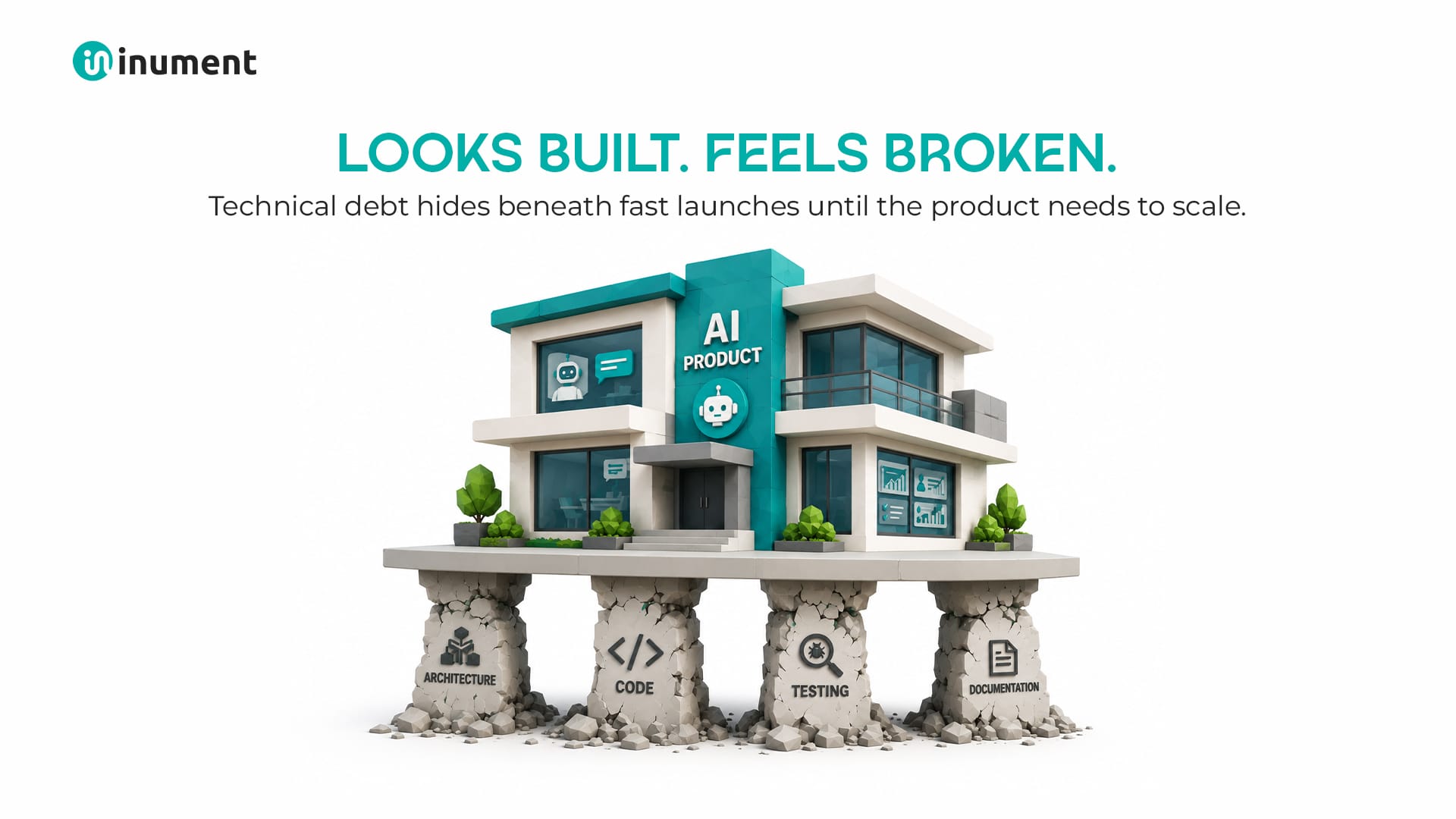
Technical debt is not just messy code. Think of it as four separate payday loans, each at a different interest rate, compounding silently in the background while your team celebrates another release.

Inument categorizes the decay into four distinct areas that paralyze engineering teams across every market, from a React JS development agency in Dhaka to a React Native development company in Berlin.

1. Architectural Debt

These are the sub-optimal system design decisions baked in during the rush: tight coupling, monolithic structures, no microservices migration strategy, and zero consideration for future multi-tenant SaaS architecture design. When you eventually need to scale, you discover you have built a house of cards, not a platform.

2. Code Debt

Quick-and-dirty shortcuts that compound into “spaghetti logic”. When you later bring in hired Python AI specialists or vetted Node.js developers for hire to extend the system, they spend their first two weeks reverse-engineering what your original team built in a 48-hour sprint. That onboarding cost is invisible on your roadmap but very visible on your burn rate.

3. Testing Debt

The 2025 audit found that 91% of failing startups had no automated tests whatsoever. Zero. Every new feature deployed into a system like this is a game of Russian roulette. Quality assurance and software testing are not glamorous. It is the difference between scaling to 100,000 users and crashing at 10,000.

4. Documentation Debt

When critical business logic lives only inside one developer’s head, you are one resignation letter away from catastrophe. As teams grow, particularly in AI staff augmentation services or IT staff augmentation for startup models where contributors rotate, “archaeological debugging” becomes a full-time job. It gets more expensive every quarter.

Takeaway: Before your next sprint planning session, assign one owner to map your current debt across all four categories. A one-hour audit today prevents a three-month crisis in Year 2.

The Year 2 Death Spiral: Where Budgets Go to Die

Here is the math that most founders only see in hindsight.

Timeline           

Innovation Budget

Maintenance  Budget

State of the Product

Year 1

70% – 80%

20% – 30%

The Sprint: high velocity, rapid releases, and the “momentum” phase.

Year 2

40% – 50%

50% – 60%

The Flip: maintenance becomes the majority. Debt knocks at the door.

Year

15% – 25%

75% – 85%

The Legacy: total gridlock. Innovation is a minor detail.

The transition from Year 1 to Year 2 is not gradual. It is a cliff edge.

Once your maintenance budget eclipses your build budget, your capacity for developing custom AI agents, releasing new features, or responding to enterprise client requests collapses almost overnight. The team that was shipping weekly is now triaging daily.

For companies with FinTech software regulatory compliance obligations or those delivering ethical AI implementation for FinTech clients, this is not merely a productivity problem; it is a legal liability. Brittle systems fail audits. Failing audits kill contracts.

2026 Data Point: Professional developers now spend 42% of their working week maintaining or fixing existing bad code rather than building new features. In typical SMBs, 72% of the IT budget goes toward basic operations, leaving just 28% for growth.

Takeaway: Calculate your own “standing-still cost”. Multiply your total monthly developer payroll by 0.42. That figure represents what you are currently paying to not fall behind, not to get ahead.

The $6 Trillion Problem: A Board-Level Risk, Not an Engineering One

Global technical debt reached $6 trillion in 2026.

That number is not a warning from engineers to CFOs. It is a warning from CFOs to boards. And it is playing out identically whether you run a custom SaaS application development firm in Manchester, an iOS and Android app development agency in Melbourne, or an enterprise software development company in Dhaka.

The financial anatomy of the problem breaks down like this:

  • The Innovation Tax: Average firms now lose 21%–40% of IT budget to debt management annually.
  • The Productivity Drain: Developers spend 42% of their week on maintenance versus creation.
  • The SMB Trap: 72% of small and medium business IT budgets go to “keeping the lights on”.

For teams considering low-code vs custom software cost trade-offs, this data matters enormously. Low-code platforms promise speed. Deliberate serverless architecture consulting or a scalable cloud-native app development strategy is necessary; otherwise, low-code platforms create the same debt categories, but with less visibility into where the bodies are buried.

Takeaway: Bring your technical debt conversation out of the engineering standup and into your next board or investor update. Frame it in dollars, not tickets.

Real-World Case Study: eBay and the Cost of Waiting

eBay is one of the best learning examples in modern software history. Not because they failed, but because they almost did.

At a critical growth juncture, legacy architectural debt caused severe latency during checkout. Every second of checkout delay translates to measurable revenue loss at eBay’s transaction volume. The root cause was not a lack of talent. It was years of prioritizing new features over foundational integrity.

Their recovery required a multi-year commitment to modernization rather than to developing new features. It was an extraordinarily difficult sell to stakeholders conditioned to celebrate shipping velocity. But they recovered nearly half of their trapped engineering value and restored the scaling capabilities that debt had frozen.

The Microsoft parallel is less discussed but equally instructive. Microsoft’s pattern of rapid feature deployment shipping with known bugs, then patching in waves, has conditioned hundreds of millions of users to delay OS and software updates. The market learned their pulse. Slow adoption became the invoice Microsoft receives for moving too fast.

This identical dynamic plays out in startups delivering healthcare mobile app development, e-commerce mobile app infrastructure, or progressive web app (PWA) development industries, where user trust, uptime, and compliance are essential requirements, not differentiators.

Takeaway: Ask your team honestly: are your users already waiting for your patches before they update? If the answer is yes, your users have already noticed what you haven’t fixed yet.

The 20% Rule: Inument’s Framework for Operational Resilience

Inument does not just diagnose the problem. We provide the framework to survive it.

The cornerstone of what we call ‘digital accountability’ is the 20% Rule: allocate one focused day per week or 20% of every sprint to structured debt repayment across three core pillars.

This is not downtime. This is the highest-ROI investment your engineering team can make in Year 1.

Pillar 1: Refactor Architectural Bottlenecks

Decouple tightly integrated services. Modularize legacy components so each can be updated independently. For teams building AI-powered automation for logistics, deploying natural language processing services at scale, or managing multi-tenant SaaS architecture design, this modularity is not optional; it is the prerequisite for everything that comes after.

Inument helps you identify and untangle these dependencies before they become Year 2 emergencies. Teams that complete this work reclaim, on average, 20% of lost engineering velocity within 90 days.

Pillar 2: Automate Quality Assurance

If you carry testing debt, you must spend your 20% time building automated regression suites immediately.

For teams that hire remote DevOps engineers, operate nearshore vs offshore staff augmentation models, or scale engineering teams on demand across multiple geographies, manual QA is not just slow; it is structurally incompatible with distributed development. Inument’s automated testing solutions replace manual QA pipelines, removing the single biggest drag on modern distributed teams.

Pillar 3: Modernize Infrastructure and Data

Research shows that moving to cloud-native solutions and remediating data lineage reduces technical debt by 18% over five years. For companies with FinTech software regulatory compliance requirements or cybersecurity audits for small business obligations auditable, documented data flows are also a legal requirement, not just a best practice.

For teams currently evaluating hiring AWS-certified cloud architects or planning a legacy system modernization services engagement, this pillar is where the long-term compounding returns live.

Takeaway: Start your 20% allocation in the next sprint. Pick the single highest-risk debt category from your audit, assign a dedicated owner, and measure velocity before and after 90 days. The numbers will do the rest of the convincing.

The Cultural Shift: Building for Business Reality, Not Demo Day

The 20% Rule is not a technical preference for any tech CEO, CTO, or founder, regardless of whether they manage a dedicated in-house software development team or operate a blended model with an offshore AI development company partner. It is a commercial hedge.

Junior developers experience debt-repayment sprints as boring maintenance. Senior engineers know the truth: it is operational resilience. It is the difference between a prototype that impresses in a pitch deck and a product that survives Year 2 without a $2M emergency rewrite.

A team that spends 80% of its time on new features is fast today and paralysed tomorrow. A team that protects 20% for foundations is still shipping confidently in year 3 and still winning clients in year 5.

This principle applies equally whether you are building mobile app maintenance and support contracts for enterprise clients in Frankfurt, delivering blockchain development for supply chain solutions in Singapore, providing augmented reality developer-for-hire services to retail brands in Chicago, or running a SaaS MVP development programme for entrepreneurs in Bristol.

The market does not care about your sprint velocity. It cares about whether your product works reliably, securely, and at scale.

Takeaway: Make operational resilience a named value in your engineering culture, not a footnote in your retrospectives. Teams that name it, fund it, and measure it consistently outperform those that treat it as optional.

A Pragmatic Path Forward

Technical debt is a loan you only have to repay if you need to change the system.

In Year 2, you always need to change everything. Markets shift. User demands evolve. Competitors release features that redefine your roadmap overnight. If your code is brittle, if your architecture cannot bend, you cannot pivot.

If your team’s velocity has dropped by 20% or more in the last quarter, you are in the slowdown. The death spiral has begun, even if the product still looks healthy from the outside.

Whether you are delivering digital transformation consulting to a global logistics firm, building enterprise mobile security solutions for a regulated financial client, or launching a custom mobile app development services offer to startups in the APAC region, the same rule applies: brittle infrastructure is a ceiling you will hit and hit hard.

At Inument, we have seen this pattern across markets in Europe, the USA, the UK, Australia, and Asia. We have helped teams recover from it, and we have helped smarter teams prevent it entirely through structured AI staff augmentation services, rigorous technical debt frameworks, and a principle we call ‘operational resilience’.

The hype of rapid experimentation is over. 2026 is the year of building things that last.

Is your product currently in the momentum phase, or are you already paying for the shortcuts of last year?

Ready to Stop the Spiral?

Inument offers a free technical debt assessment for product teams at every stage. Whether you need a full offshore AI development company partner, targeted AI staff augmentation services to fill critical gaps, or a strategic digital transformation consulting engagement to redesign your foundation, we have the framework, the team, and the track record.

Visit inument.com to book your free assessment.
Read what clients across Europe, the USA, the UK, and Asia say. Search Inument Solutions Ltd reviews to see the results firsthand.

Build fast. But build to last.

About the Author

Theotonius Baroi

Theotonius Baroi

Want to Build Your Dream Tech Team? Hire Now!

Great Code Isn’t Enough: Why Inument’s AI Staff Augmentation Services Need Strong Communication to Deliver ROI

Great Code Isn’t Enough: Why Inument’s AI Staff Augmentation Services Need Strong Communication to Deliver ROI

2 June 2026

|

IconInument

Icon Icon Icon
Great_Code_Isn’t_Enough_Inument's_AI_Staff_outsourcing_is_essential_inument

The biggest software risk in 2026 is not bad code. It is building the wrong thing beautifully.

Companies across Europe, the USA, the UK, Australia, and Asia are investing heavily in AI, cloud, SaaS, automation, and remote engineering teams. But the market has changed. A few years ago, a new app, dashboard, AI chatbot, or automation tool could sound impressive simply because it felt innovative. Today, leaders are asking harder questions.

  • Will it reduce cost?
  • Will it improve revenue?
  • Will it make the team faster?
  • Will customers actually use it?
  • Will it reach production and create measurable ROI?

This is why great code is no longer enough. A dedicated software development team must communicate clearly, understand business priorities, and connect every technical decision to a real outcome.

At Inument, this matters deeply because the work often begins with AI staff augmentation services, custom AI agent development, custom SaaS application development, or support as an offshore AI development company. But behind every technical request, there is always a business question.

Takeaway: In 2026, software teams are not judged only by what they build. They are judged by what the business gains from it.

Why This Topic Matters in 2026

The software market is entering an ROI reckoning. IT spending is growing, AI investment is rising, and enterprises are moving faster. But bigger budgets do not automatically create better products.

The real challenge is alignment.

A company may hire LLM engineers in 2026, hire Python AI specialists, hire remote React developers in 2026, or bring in vetted Node.js developers for hire. These are smart moves when the skills are missing internally. But skilled developers still need strong direction.

A React developer needs to understand the user journey. A Node.js developer needs to understand the workflow behind the API. A Python AI specialist needs to know which decision the model should improve. A DevOps engineer needs to know the uptime, cost, and release expectations.

Without that context, even a strong dedicated software development team can produce output without creating value.

This is especially important for companies comparing nearshore vs offshore staff augmentation. Location, cost, and time zone overlap matter. But communication quality matters more. A low-cost team that does not understand your business can become expensive rapidly.

Takeaway: Before you scale the engineering team on demand, make sure the team understands why the work matters.

The Hidden Problem: Conceptual Bugs

Software teams are trained to find technical bugs. They check broken logic, API failures, slow load times, security gaps, and poor user flows.

But one of the most expensive problems is not a technical bug. It is a conceptual bug.

A conceptual bug happens when the software works, but it solves the wrong problem.

  • The code runs.
  • The interface looks clean.
  • The deployment succeeds.
  • But the feature does not improve the business.

Such scenarios happen more often than teams admit.

A retailer builds a dashboard, but decision-makers still rely on spreadsheets. A logistics company invests in AI-powered automation for logistics, but the manual process behind it remains unclear. A FinTech company adds AI scoring, but ethical AI implementation for FinTech and FinTech software regulatory compliance were not considered early enough. A SaaS startup launches quickly but later discovers that the system needs a multi-tenant SaaS architecture design before it can grow.

In 2026, AI makes this risk bigger. Generative AI can speed up coding, testing, and documentation. But it is less useful when requirements are vague. That means unclear thinking becomes expensive faster than before.

This is why communication must come before development.

Takeaway: Do not only ask, “Can we build it?” Ask, “Are we solving the right problem?”

Correct Code Can Still Fail

Correct code can still fail if the team is misaligned.

One team understands the requirement one way. Another team understands it differently. A business stakeholder assumes one workflow. The developer builds another. A model performs well in testing but fails with real users. A deployment works technically but creates operational confusion.

The software did what it was asked to do. The problem is that the team asked it to do the wrong thing.

This matters even more in advanced technology projects such as generative AI integration for enterprise, custom AI agent development, natural language processing services, predictive analytics solutions for retail, and MLOps consulting services.

These solutions can create real value. But they need clarity.

A custom AI agent should have defined boundaries.
An NLP system should have a clear use case.
A predictive analytics platform should improve a business decision.
An MLOps setup should support monitoring, retraining, governance, and safe deployment.

AI does not remove the need for communication. It increases it.

Think of software like a high-performance car. Great code is the engine. Communication is the steering wheel. Without steering, speed only helps you reach the wrong destination faster.

Takeaway: The more powerful the technology, the more important the alignment.

The Code-First Trap

Many teams think starting development quickly means moving fast.

In reality, starting too early often creates rework.

A product manager requests a feature. Engineers begin building. Then stakeholders add new requirements. Then users behave differently than expected. Then QA finds gaps. Then the architecture needs to change. Then the release date slips.

The team was busy the whole time, but the business did not move forward.

This is the code-first trap.

It affects startups, scale-ups, and enterprises. It also affects companies looking for IT staff augmentation for startups, temporary IT staffing solutions, dedicated software development team support, or software development outsourcing in 2026.

The benefits of IT staff augmentation in 2026 are clear: faster access to talent, flexible scaling, specialized skills, and lower hiring commitment. But staff augmentation should not mean adding random developers to a backlog.

The real value comes when augmented engineers become part of the product thinking.

They should understand the business goal, customer pain, technical risk, release priority, and success metric. That is when AI staff augmentation services become more than capacity. They become a strategic delivery advantage.

Takeaway: Do not add people only to move faster. Add clarity so the team moves in the right direction.

Architecture Should Match the Business Stage

Good engineering is not about using the most fashionable stack. It is about choosing what the business actually needs right now.

A startup may need SaaS MVP development for entrepreneurs, not a complex enterprise system. A growing SaaS company may need scalable cloud-native app development and multi-tenant SaaS architecture design. An established business may need services to modernize legacy systems because old systems are slowing down operations.

Some companies need serverless architecture consulting to reduce infrastructure complexity. Others need a microservices migration strategy because the current platform has become too large and fragile. Some need to hire AWS-certified cloud architects to control cost, security, and scalability.

The same logic applies to mobile.

A company may need custom mobile app development services, an iOS and Android app development agency, a React Native development company, or to hire Flutter developers for cross-platform delivery. But the discussion should not stop at the framework.

The team must also think about mobile app UI/UX design trends in 2026, enterprise mobile security solutions, mobile app maintenance and support, performance, retention, and future scalability.

Healthcare mobile app development needs extra care around privacy, trust, and usability. E-commerce mobile app specialists need to think about conversion, checkout friction, loyalty, and personalization. An augmented reality developer for hire may be useful for certain use cases, but you should only add AR when it improves the user experience.

The best technical decision is not the most advanced one. It is the one that fits the business stage.

Takeaway: Choose architecture based on business reality, not technology fashion.

Quality Is Part of ROI

Quality assurance and software testing are often treated as final steps. That is a mistake.

Quality protects ROI.

A broken release damages trust. A slow app reduces conversion. A weak security model creates risk. A poorly tested SaaS platform increases support costs. A badly monitored AI model can produce unreliable decisions.

In 2026, speed without reliability is not an advantage.

Testing should cover business logic, user experience, performance, integrations, security, and maintainability. For AI systems, it should also include data quality, model drift, accuracy, explain ability, and human review. For cloud-native systems, it should include observability, uptime, rollback planning, and disaster recovery.

This stage is also where services like cybersecurity audits for small businesses, enterprise mobile security solutions, and MLOps consulting services become important. Security, reliability, and governance should not be added after launch. They should be part of the build process.

Even emerging areas such as blockchain development for supply chains need the same discipline. The technology may sound advanced, but the question remains simple: does it reduce fraud, improve traceability, or create operational value?

Takeaway: Software is not finished when it is deployed. It is finished when it performs reliably in the real world.

Practical Breakdown: How to Build with Clarity

Strong communication does not mean endless meetings. It means creating a shared understanding before the team spends expensive engineering time.

Here is a simple framework. Inument recommends:

1. Define the business problem

Before writing code, ask what is currently slow, expensive, risky, or painful. This helps avoid building features that look useful but do not change outcomes.

2. Map the user journey

Every technical feature should connect to a real user action. This is important for SaaS, mobile, retail, healthcare, logistics, and FinTech products.

3. Choose the right delivery model

Compare low-code vs custom software costs carefully. Low-code may work for internal workflows. Custom software may be better when scalability, security, user experience, or competitive advantage matters.

4. Match talent to the roadmap

You may need to hire remote DevOps engineers, hire Python AI specialists, hire LLM engineers in 2026, or hire remote React developers in 2026. But hire based on roadmap needs, not buzzwords.

5. Set success metrics early

Define what should improve after launch: cost, speed, conversion, adoption, uptime, customer satisfaction, or revenue.

6. Review communication weekly

A dedicated software development team should review not only tasks, but also assumptions, blockers, risks, and business changes.

Takeaway: Clear communication is not a soft skill. It is an ROI control system.

Mini Case Study: From AI Idea to Business Outcome

Imagine a retail company wants predictive analytics solutions for retail. The first request sounds simple: build a dashboard to forecast demand.

A code-first team may immediately start designing charts, connecting data sources, and building the interface.

A communication-first team asks different questions.

  • Who will use the forecast?
  • Which decision will it improve?
  • Is the data clean enough?
  • How often should the model update?
  • What happens when the forecast is wrong?
  • How will the business measure success?

After discovery, the team may realize the real problem is not the dashboard. The real problem is delayed inventory decisions across regions. The better solution may include clean data pipelines, demand forecasting, role-based alerts, and integration with existing planning tools.

This is how a dedicated software development team creates ROI. Not by writing more code, but by building the right system.

The same approach works for AI-powered automation for logistics, natural language processing services, custom AI agent development, progressive web app development, and digital transformation consulting.

This is also why many companies searching for the best IT outsourcing countries in Asia should not look only at cost. They should look for communication maturity, technical depth, process discipline, and business understanding.

Takeaway: The right partner does not just accept requirements. The right partner improves them.

The Inument Way

Inument’s approach is simple: communicate before building, validate before scaling, and connect every technical decision to business value.

When clients come to Inument for AI staff augmentation services, enterprise software development in Dhaka, React JS development agency support, custom SaaS application development, legacy system modernization services, or scalable cloud-native app development, the work does not begin with code.

It begins with questions.

  • What business problem are we solving?
  • Who will use this system?
  • What process is currently slow or expensive?
  • What metric should improve?
  • What should we avoid building?
  • What risks should we remove early?
  • How will success be measured after launch?

This is how Inument reduces conceptual bugs, prevents feature bloat, and helps engineering become a strategic function instead of only a production function.

For companies searching for Inument Solution Ltd reviews, the better question is not only, “Can this team build software?” The better question is, “Can this team understand our business and help us build the right software?”

That is where Inument aims to distinguish itself as an offshore AI development company and remote engineering partner.

Takeaway: The best engineering partners do not only provide developers. They help you make better technical decisions.

Conclusion: Build With Clarity, Not Just Speed

Great code still matters. Clean architecture matters. Strong developers matter. AI, cloud, SaaS, DevOps, mobile, and automation all matter.

But none of them matter enough if the team is solving the wrong problem.

A company can have a fast CI/CD pipeline, modern infrastructure, beautiful UI, and advanced AI models. But if the product does not improve the customer experience, reduce cost, increase revenue, or improve operations, the business still loses.

Communication is what keeps engineering on the right track.

  • It connects strategy with execution.
  • It connects product ideas with user needs.
  • It connects architecture with growth.
  • It connects AI ambition with operational reality.

Great code is the engine. Communication is the steering wheel.

At Inument, we help companies build technology that does not just launch. We help them build systems that perform, scale, and create measurable business value.

Whether you are building an AI product, modernising a legacy system, scaling a SaaS platform, strengthening a mobile app, or growing your engineering team, the rule for 2026 is clear:

Do not just build faster. Build with clarity. Build with purpose. Build for ROI.

About the Author

Theotonius Baroi

Theotonius Baroi

Want to Build Your Dream Tech Team? Hire Now!

Unlocking Business Potential: Scaling with AI Transformation, Not Additional Hirings

Unlocking Business Potential: Scaling with AI Transformation, Not Additional Hirings

13 May 2026

|

IconInument

Icon Icon Icon
Unlocking_Business_Potential_Scale_with_AI_Transformation_inument

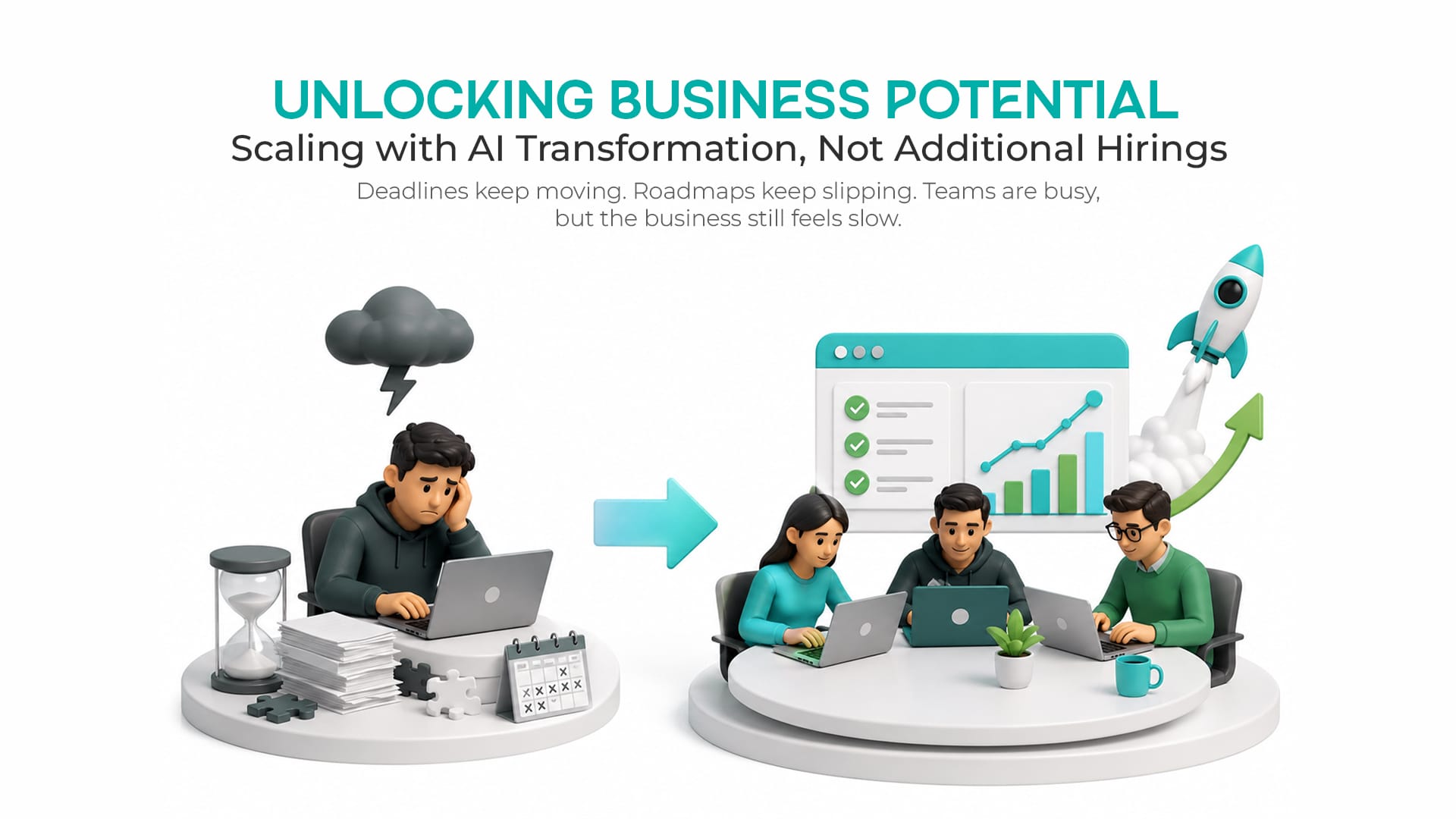
Deadlines keep moving. Roadmaps keep slipping. Teams are busy, but the business still feels slow.

For years, the default answer was simple: hire more engineers.

More people meant more output. More headcount meant more delivery capacity. More developers meant faster execution.

That logic is not completely wrong. But the market has changed.

AI has changed how companies build, operate, scale, and compete. Today, the real question is not just, “How many engineers do we need?”

What parts of our business should be automated, optimized, or transformed with AI?

Because in many companies, the problem is no longer just a lack of people. The problem is that teams are still solving modern business challenges with old delivery models.

Hiring more engineers may add capacity. But it will not automatically create AI transformation.

  • It will not redesign your workflows.
  • It will not build intelligent automation.
  • It will not turn scattered data into decision-making systems.
  • It will not create AI agents that can support operations, sales, customer service, or internal productivity.

That requires a different approach.

The Hidden Cost of Solving Every Problem with People

Hiring looks like progress from the outside.

A bigger team feels safer. More engineers feel like they have more control. More people in the delivery pipeline feels like momentum.

But in reality, every new hire brings a cost before they bring value.

  • You need time to recruit.
  • You need time to interview.
  • You need time to onboard.
  • You need time to explain your systems, your business logic, your product gaps, your data, and your internal processes.

By the time a new engineer becomes fully productive, months may have already passed.

And in the AI era, time matters even more.

Because your competitors are not only hiring. They are automating. They are building AI agents. They are using machine learning to improve decisions. They are reducing manual work from internal operations. They are making their products smarter.

So if your only answer is “let’s hire more people,” you may still move forward but not fast enough.

The real cost is not just salary.

The real cost is delayed transformation.

Why Traditional Delivery Breaks in the AI Era

Traditional software delivery was mostly about building features.

  • A dashboard.
  • A mobile app.
  • A portal.
  • A reporting system.
  • An integration.
  • A workflow.

These are still important. But AI-led businesses need more than software features. They need intelligent systems.

That is where traditional delivery starts to struggle.

1. Manual workflows stay manual

Many companies have teams doing repetitive work every day: checking documents, responding to the same questions, processing requests, reviewing data, preparing reports, routing tickets, qualifying leads, or making routine decisions.

Hiring more people may reduce pressure temporarily.

But AI can remove the repetitive work from the system entirely.

2. Data exists, but intelligence does not

Most companies already have data.

Sales data. Customer data. Product data. Operational data. Support data. Finance data.

But the data is often scattered across systems, spreadsheets, CRMs, dashboards, and internal tools.

Without AI and ML, that data stays passive. It tells you what happened, but not what to do next.

3. Teams are busy, but decisions are slow

Business teams often wait for reports, approvals, analysis, or manual follow-ups.

AI agents can help here by connecting tools, reading context, taking action, and supporting decisions faster.

This is where Agentic AI becomes important. It is not just about asking a chatbot questions. It is about building systems that can perform tasks, trigger workflows, and support real business execution.

4. AI experiments do not become production systems

Many companies are testing AI. Very few are operationalizing it properly.

  • A demo is easy.
  • A real AI system is harder.

The real challenge is not creating a prototype. The challenge is integrating AI into actual workflows, business rules, data pipelines, user experience, security, and measurable outcomes.

That is where strong AI engineering matters.

The Shift: From Staff Augmentation to AI Transformation

Staff augmentation still has value when a company needs engineering capacity.

But Inument’s direction has evolved.

The bigger opportunity now is not just helping companies add more developers. It is helping companies become AI-enabled businesses.

That means focusing on:

  • AI transformation
  • Agentic AI systems
  • AI agents
  • Machine learning solutions
  • AI-powered workflow automation
  • Data intelligence
  • Intelligent product development
  • Production-ready AI integration

This is not about replacing people.

It is about helping people work with better systems.

AI transformation means looking at a business and asking the following:

  • Where is time being wasted?
  • Where are decisions delayed?
  • Where is data underused? 
  • Where are teams repeating the same work?
  • Where can AI improve speed, accuracy, and customer experience?
  • Where can intelligent automation create measurable business value?

That is a very different conversation from simply asking how many developers a company needs.

What AI Transformation Looks Like in Practice

AI transformation is not one single product. It depends on the business problem.

For one company, it may mean building an AI agent that supports customer service teams by answering queries, summarizing cases, and routing issues.

For another company, it may mean using machine learning to predict customer behavior, detect fraud, personalize recommendations, or improve operational planning.

For another, it may mean building an internal AI assistant that helps employees find policies, documents, reports, and business information instantly.

For a product company, it may mean embedding AI into the product itself so users get smarter search, better recommendations, automated insights, or faster decision support.

The point is simple:

AI transformation should not be treated as a technology trend.
It should be connected to business outcomes.

Faster operations.

  • Lower manual workload.
  • Better decisions.
  • Smarter products.
  • Higher customer satisfaction.
  • Reduced cost.
  • Stronger competitive advantage.

AI Agents Are Changing How Work Gets Done

AI agents are becoming one of the most practical parts of AI transformation.

A basic chatbot can answer questions.

An AI agent can go further.

It can understand context, connect with business systems, follow rules, complete tasks, generate outputs, and support workflows.

For example, an AI agent can:

  • Review incoming customer requests and classify them
  • Summarize sales calls and update CRM notes
  • Generate internal reports from multiple data sources
  • Help HR teams answer policy questions
  • Support finance teams with document checks
  • Assist operations teams with repetitive coordination
  • Guide users through complex business processes
  • Trigger actions inside connected tools

This is where companies start seeing real value.

Because the goal is not to “use AI.”
The goal is to remove friction from the business.

Machine Learning Still Matters

With all the attention on AI agents and generative AI, many companies forget that machine learning is still one of the strongest foundations for business intelligence.

ML is especially powerful when the problem involves prediction, classification, scoring, detection, recommendation, or optimization.

For example:

  • Predicting customer churn
  • Detecting fraud or unusual behavior
  • Recommending products or content
  • Scoring leads based on conversion potential
  • Forecasting demand
  • Optimizing pricing or inventory
  • Identifying risk patterns
  • Personalizing user experiences

Generative AI is powerful for language, reasoning, and interaction.

Machine learning is powerful for patterns, predictions, and decisions.

The strongest AI transformation strategies often use both.

Why AI Transformation Needs Engineering Discipline

AI is not magic. And AI transformation does not happen by simply adding a model into a product.

To make AI work in the real world, companies need strong engineering.

  • They need clean data pipelines.
  • Secure architecture.
  • Proper integrations.
  • Reliable APIs.
  • Human review layers where needed.
  • Monitoring and performance tracking.
  • Clear business rules.
  • Scalable infrastructure.
  • Good UX around AI outputs.

Without this, AI becomes a fancy demo that never creates business value.

This is where Inument’s role becomes clear.

The future is not only about providing engineering hands. It is about combining software engineering, AI, ML, cloud, data, and product thinking to build systems that actually work inside real businesses.

The Right Question to Ask Now

When delivery is slow, many companies still ask:

“Who do we need to hire?”

But in the AI era, the better question is:

“What should we transform first?”

Because sometimes the answer is not another developer.

  • Sometimes the answer is an AI workflow.
  • Sometimes it is an AI agent.
  • Sometimes it is a machine learning model.
  • Sometimes it is better data infrastructure.
  • Sometimes it is automating a process that should not be manual anymore.
  • Sometimes it is rebuilding a product around intelligence, not just features.

The companies that understand this early will move faster than the companies that only keep increasing headcount.

Key Takeaways

  • Hiring more engineers can increase capacity, but it does not automatically create transformation.
  • AI has changed the business strategy. Companies now need to think beyond people and focus on intelligent systems.
  • Agentic AI and AI agents can reduce manual work, speed up decisions, and support real business execution.
  • Machine learning remains critical for prediction, personalization, detection, and optimization.
  • AI transformation only works when it is connected to real business outcomes, not just demos or experiments.
  • The future of delivery is not only about bigger teams. It is smarter systems.
  • For Inument, this is the shift.
  • From helping companies scale engineering capacity to helping companies build AI-powered businesses.

If your roadmap keeps slipping, the answer may not be another job posting. It may be the workflow, the data, or the manual process slowing your business down. Before adding more people, start by identifying what can be automated, optimized, or transformed with AI. Because the future of scaling is not just bigger teams. It is smarter systems.

About the Author

Theotonius Baroi

Theotonius Baroi

Want to Build Your Dream Tech Team? Hire Now!