The Secret Behind Why Startups and Enterprises Prefer React JS

The Secret Behind Why Startups and Enterprises Prefer React JS

30 December 2025

|

IconInument

Icon Icon Icon
react-js-for-startups-and-enterprises

If you’re in the world of web development, React JS isn’t just another JavaScript library. It’s the engine behind some of the world’s most dynamic web and mobile applications. 

From scrappy startups racing to launch their MVPs to enterprise giants maintaining complex platforms, React has emerged as the go-to choice for developers who need speed, flexibility, and scalability.

But why does it resonate so strongly across businesses of all sizes? 

The secret lies in its component-based architecture, reusable code, and vibrant ecosystem, which make it easier to build fast, maintain efficiently, and scale without chaos. 

This is why React JS has become the go-to framework for modern web development.

In this guide, we’ll explore why startups and enterprises alike prefer React JS, breaking down the benefits, real-world applications, and what makes it stand out from other JavaScript frameworks.

If you’re looking to build faster, smarter, and more efficiently, understanding why React JS is considered as the framework of choice is your first step.

So, let’s get right into it!

What is React JS? A Quick Overview

At its core, React JS is a JavaScript library for building interactive user interfaces. It allows developers to break down complex applications into reusable components, making development faster, more organized, and easier to maintain. 

Unlike traditional frameworks, React focuses solely on the view layer, giving developers the flexibility to integrate it with other tools and libraries seamlessly.
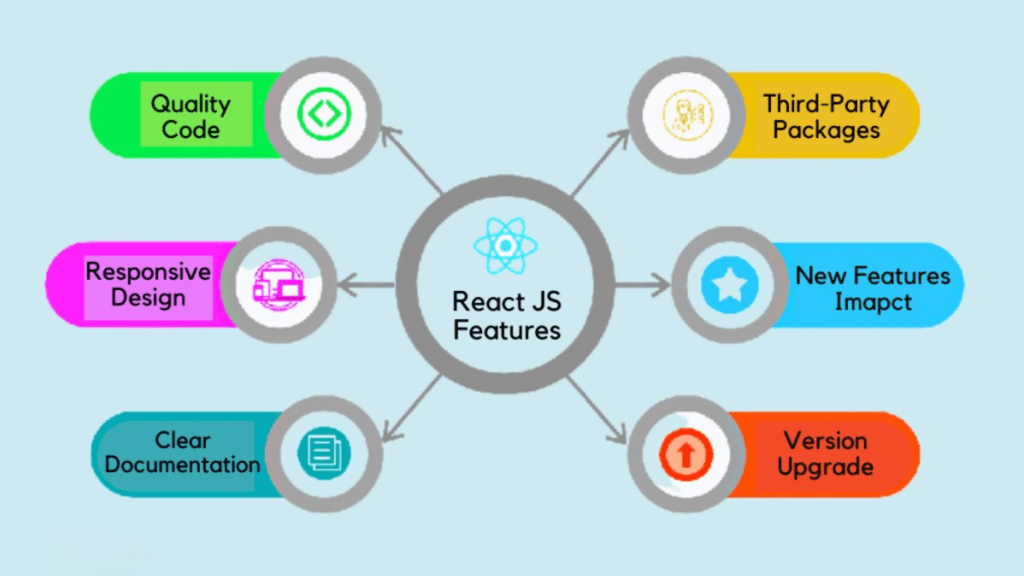
Here are the key features that make React stand out:

  • Component-Based Architecture: Build reusable UI elements that can be shared across your application, saving time and reducing errors.
  • Virtual DOM: React efficiently updates only the parts of the UI that change, improving performance for large-scale apps.
  • JavaScript XML (JSX): JSX connects Javascript with dynamic UI components/markups in a coherent environment, making the development experience more intuitive.   
  • Flexibility and Ecosystem: It integrates smoothly with other libraries, frameworks, and backend technologies, making it adaptable for both small startups and complex enterprise systems.

These characteristics explain why both startups and enterprises are increasingly leaning on React. 

Startups benefit from speed and rapid prototyping, while enterprises enjoy scalability, maintainability, and performance optimization.

React isn’t just popular. It’s strategically smart for businesses looking to stay ahead in today’s fast-moving digital landscape.

Now, let’s explore what’s so special about React JS that every company, from startup to enterprises keep choosing it.

The Reason Why Startups Love React JS

Startups move fast, and they need a framework that can keep up without slowing them down. 

React JS has emerged as a favorite because it allows teams to build, iterate, and scale with remarkable efficiency.

Here are the key reasons startups across the globe keep turning to React JS: 

  1. High Performance: Specifically after React introduced virtual DOM, their performance skyrocketed. This guarantees optimum performance even in traffic-heavy, large-scale applications. 
  2. Speed and Flexibility: React’s component-based architecture, fast learning curve, and easy integration make it easy to build features quickly. Even startups with limited resources and tight timelines can launch MVPs in record time and pivot without rewriting the entire app.
  3. Rapid Prototyping: With reusable components and a rich ecosystem of libraries, developers can spin up prototypes fast, test ideas with users, and gather feedback before committing to full-scale builds.
  4. Active Community and Open Source: React benefits from a huge developer community and extensive open-source resources. Startups can leverage existing components, plugins, and tools to save time and costs.
  5. Cost Efficiency: Time is money, and React helps startups maximize output with smaller teams. Less repetitive coding and faster feature development reduce development costs while accelerating time-to-market.

In short, React JS gives startups a competitive edge, allowing them to innovate faster, adapt quickly, and focus on growth rather than getting bogged down by technical limitations.
Is your startup looking to build fast and smart? 

React JS might just be your secret weapon!

Why Enterprises Rely on React JS

Enterprises face unique challenges: complex applications, large user bases, and high performance demands. React JS addresses these challenges, making it the go-to framework for scalable, maintainable, and efficient software development.

Here’s why large enterprises trust React JS for developing scalable, maintainable, and future-proof applications:

  • Scalability and Performance: React’s virtual DOM ensures applications remain fast, even with heavy data rendering and complex workflows. Enterprises can deliver smooth, responsive experiences without sacrificing performance.
  • Easy Maintainability: React’s component-based structure makes large codebases easier to manage. Teams can reuse components, update features independently, and maintain consistency across sprawling applications.
  • Cross-Platform Compatibility: With React Native, enterprises can use a single codebase for web and mobile apps, reducing development costs and streamlining maintenance.
  • Future-Proofing: React integrates smoothly with modern tools and libraries, allowing enterprises to adopt new technologies and adapt to changing business needs without overhauling their systems.

The takeout?

React JS empowers enterprises to scale confidently, maintain high-quality software, and deliver consistent, engaging user experiences across platforms; all while keeping development efficient and cost-effective.

React JS vs. Other Frameworks: Why Does It Stand Out?

When it comes to modern web development, choosing the ideal JavaScript framework can make or break your project.

While Angular, Vue, and React all offer ways to build modern web applications, React’s popularity among startups and enterprises comes from its flexibility, performance, and ecosystem. 

Here’s a breakdown of how each stacks up and when React shines:
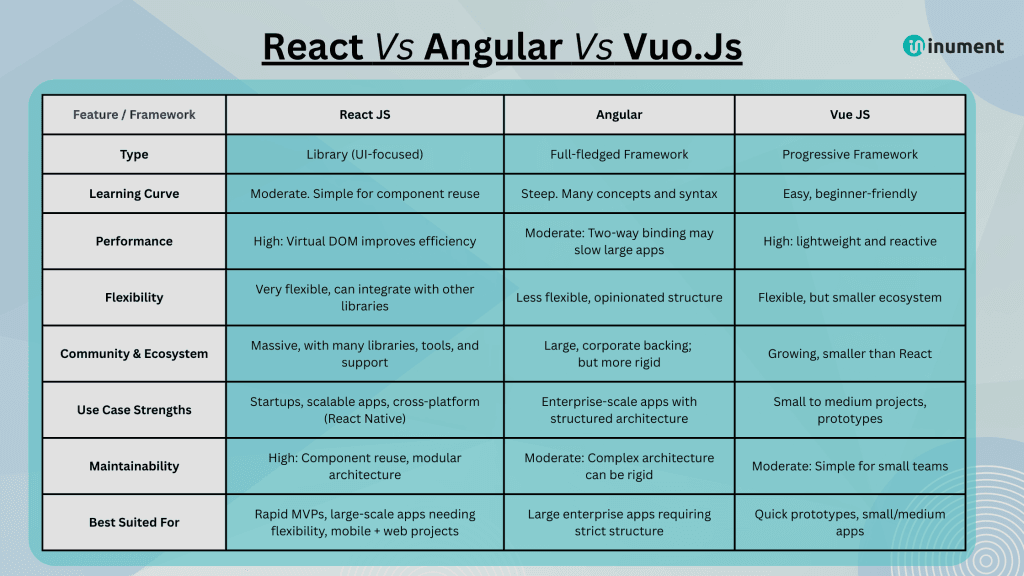
react-js-vs-angular-vs-vue-js

When React is the Better Choice

React isn’t just the flavor of the month. It’s the Swiss Army knife of web development. 

React isn’t perfect for everything, but when speed, flexibility, and scalability matter, it’s the framework that lets your product keep up with your ambition.

Here’s a look at scenarios where React’s flexibility, performance, and ecosystem give it a clear edge over Angular and Vue.

  1. Rapid MVPs – Need to get your idea off the whiteboard and into users’ hands yesterday? React’s component-based system lets you launch fast and iterate faster.
  2. Cross-Platform Magic – Web or mobile? Don’t choose. React Native lets you do both without rewriting your app. Your team’s code works smarter, not harder.
  3. Scaling Like a Pro – Growing user base? Heavy data? React’s virtual DOM keeps your app lightning-fast even when things get intense.
  4. Flexibility Without the Fuss – React plays nice with other libraries and frameworks. Want to mix, match, or swap tech stacks mid-project? React’s your best friend.
  5. Community Power – From pre-built components to plugins and endless tutorials, React’s massive ecosystem means you’re never reinventing the wheel.

In the end, the best framework depends on your project’s needs, team expertise, and scalability goals.

For many startups and enterprises, React offers the right balance of speed, flexibility, and long-term maintainability, making it the preferred choice for modern, high-performance applications.

If your team wants a framework that grows with your business, React JS becomes the smart choice.

Still unsure? Let’s take a closer look at how React can benefit your business.

Key Benefits of Using React JS for Startups and Enterprises

React JS isn’t just a trend. It’s a strategic choice that gives both startups and enterprises a serious edge. 

Here’s why businesses across the board are betting on it:

  • Faster Development Cycles – React’s component-based architecture allows teams to reuse code and build features faster. Less time reinventing the wheel, more time launching features that matter.
  • Scalability Without Chaos – Whether you’re a lean startup or a sprawling enterprise, React lets you scale your app without turning your codebase into a tangled mess. Reusable components and modular design make growth smooth.
  • Cross-Platform Flexibility – React Native lets you take the same codebase from web to mobile. Startups save time, enterprises save money, and everyone enjoys a consistent user experience.
  • Strong Community & Ecosystem – With a massive community and an endless supply of open-source libraries, tools, and integrations; React gives you support and shortcuts to solve problems before they even hit your backlog.
  • Maintainability & Future-Proofing – Enterprises love React because modular, reusable code makes updates easier, bugs easier to fix, and future integrations a breeze. Your app evolves without breaking everything else.
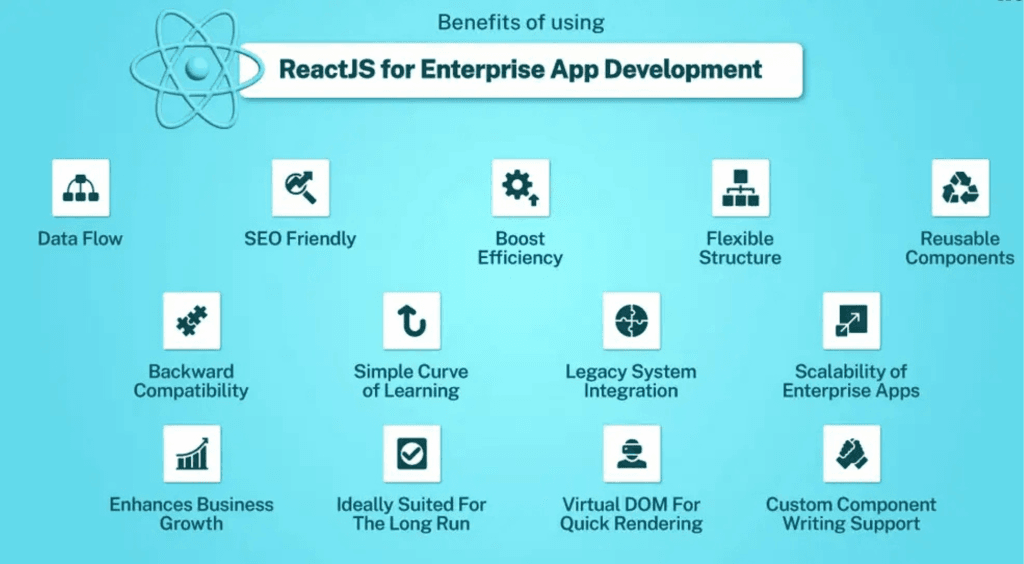
React JS gives startups the speed and flexibility to iterate fast and stay competitive, while giving enterprises the structure and scalability they need for complex, high-performance applications. As a result, it’s a win-win for teams of any size.

If you’re looking to get ahead of the competition, React can help you deliver faster, smarter, and more efficiently.

Ready to Scale? Inument Delivers Top-tier React Developers

When it comes to scaling your business with React, having the right team is crucial. 

This is why Inument delivers on-demand, highly experienced React developers who can seamlessly integrate into your existing team or take on full-scale development projects. 

Whether you’re building a new MVP, optimizing a complex system, or looking to expand your platform, our React experts have the technical prowess and business acumen to bring your vision to life.

With Inument’s flexible staff augmentation model, you get the expertise you need, when you need it, without the long hiring process. 

Partnering with Inument means you can:

  1. Speed up development: Launch faster with expert developers ready to dive into your projects immediately.
  2. Scale seamlessly: Our developers are equipped to handle everything from small apps to complex enterprise systems, ensuring your business can grow without technical bottlenecks.
  3. Access a rich talent pool: Inument’s developers bring diverse experience, including specialized expertise in React, React Native, and other complementary technologies.
  4. Reduce costs: Avoid the overhead of hiring and training. Get top-tier talent on demand without the long-term commitment.

At Inument, we don’t just provide developers. We provide the talent that fuels your growth. 

Ready to scale your business with React? Feel free to reach out and start hiring React developers that’ll help you build your next successful project.

Wrapping Up: Is React JS Right for Your Business?

React JS has earned its spot as the framework of choice for startups and enterprises alike. Its speed, flexibility, and scalability make it perfect for building apps that need to grow, iterate, and adapt without constantly rewriting the codebase. 

For startups, it’s all about rapid prototyping, fast iterations, and cost-effective development. 

For enterprises, it’s about maintainability, cross-platform consistency, and long-term scalability. 

Either way, React JS gives your team the tools and structure to turn ambitious ideas into reality.

When it comes to building scalable React applications, Inument stands out. We specialize in creating custom React solutions, whether you’re launching a new MVP or enhancing a complex enterprise platform. 

Our pre-vetted developers, agile practices, and deep technical expertise ensure that your extended or in-house team works seamlessly to deliver quality, on-time, and within budget. 

Ready to stop guessing and start building React apps that actually scale? 

Inument is here to help you turn your ideas into high-performing, future-ready products. 

Contact us today to see how we can help turn your vision into a high-performing, future-ready product.

Don’t wait, your next breakthrough starts now.

About the Author

admin

admin

Want to Build Your Dream Tech Team? Hire Now!

AI/ML Engineer Hiring Guide: How to Find Engineers Who Actually Understand Your Data

AI/ML Engineer Hiring Guide: How to Find Engineers Who Actually Understand Your Data

23 December 2025

|

IconInument

Icon Icon Icon
Ai-ml-engineer-hiring-guide

Everyone’s talking about AI.

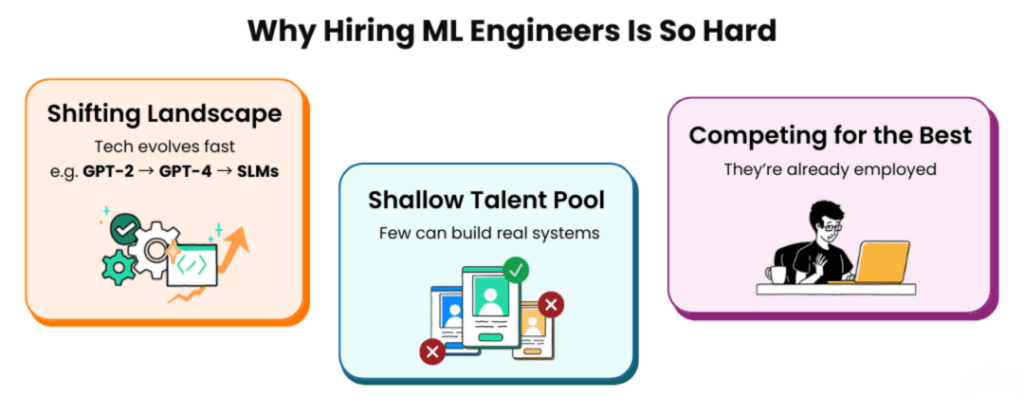
But here’s the catch: while startups are rushing to “add AI,” few actually know who they need to make it work.

You don’t just need someone who can train a model. You need someone who understands your data, your product, and your goals. 

Because a model that predicts without context is like a GPS that doesn’t know where you’re starting from.

Hiring the right AI/ML engineer isn’t just about technical brilliance. It’s about finding a partner who can translate your messy data into meaningful business outcomes. Someone who knows when to experiment, when to optimize, and when to ship.

And that’s where most teams go wrong: they hire fast, not smart. 

The result? Over-engineered models, ballooning costs, and “AI projects” that never see daylight.

This guide walks you through how to avoid that, step by step. You’ll learn how to define your needs, craft job descriptions that attract real talent, and screen candidates who can actually deliver value.

Because in today’s AI race, you don’t need more engineers.

You need the right one, and here’s how you do it —

Step 1: Define Your AI/ML Goals Before You Hire

Before you post that job on LinkedIn and pray for the next “AI wizard” to appear, pause for a moment.

Ask yourself one question: 

“Why do we actually need an AI/ML engineer?”

If your answer sounds anything like “because everyone’s doing it,” it’s time to dig deeper.

AI works best when tied to a clear business outcome. Do you want to:

  • Automate manual processes?
  • Predict customer behavior?
  • Optimize supply chain decisions?
  • Build personalization or recommendation engines?

Each of these goals requires a different type of engineer and a different set of skills.

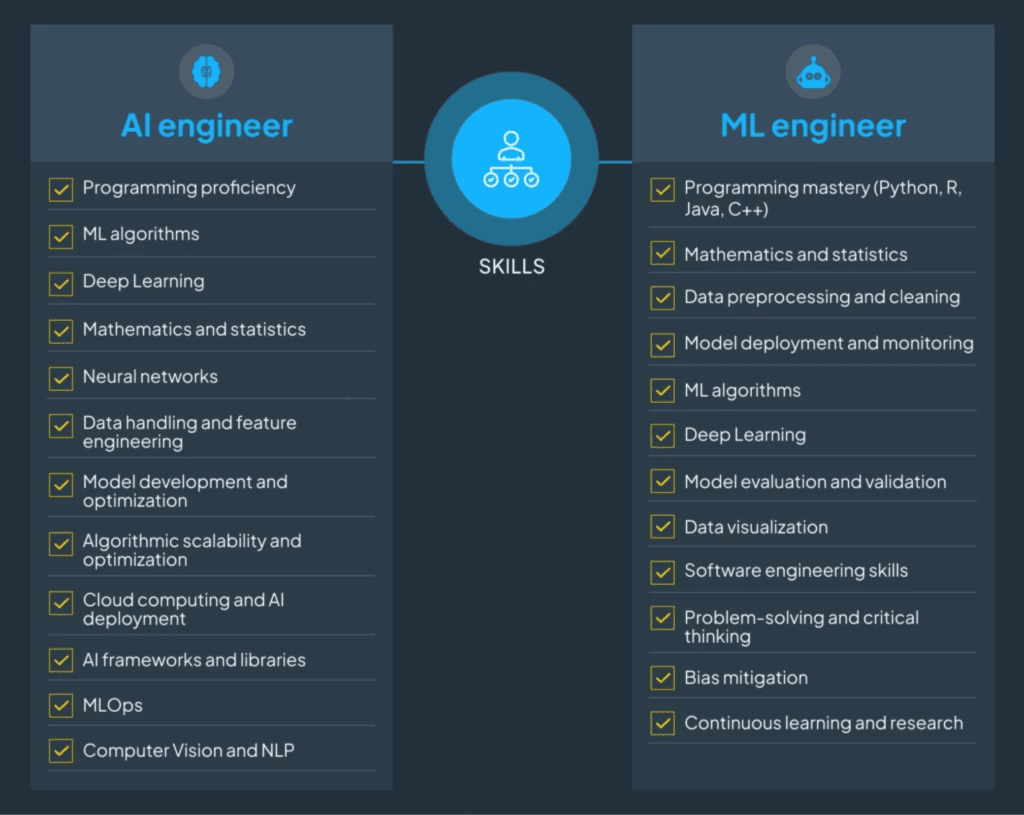
For instance:

  • Data Scientists are great at exploring data, running experiments, and finding insights.
  • Machine Learning Engineers focus on turning those insights into production-ready models.
  • AI Engineers take it one step further, embedding intelligence directly into your products and workflows.

Without this clarity, you’ll end up with mismatched expectations: someone skilled in computer vision trying to optimize your logistics data, or a researcher lost in a product sprint.

So, before you hire, write down:

  1. The problem you’re solving.
  2. The data you already have (and how clean it is).
  3. The measurable outcome you expect in 3–6 months.
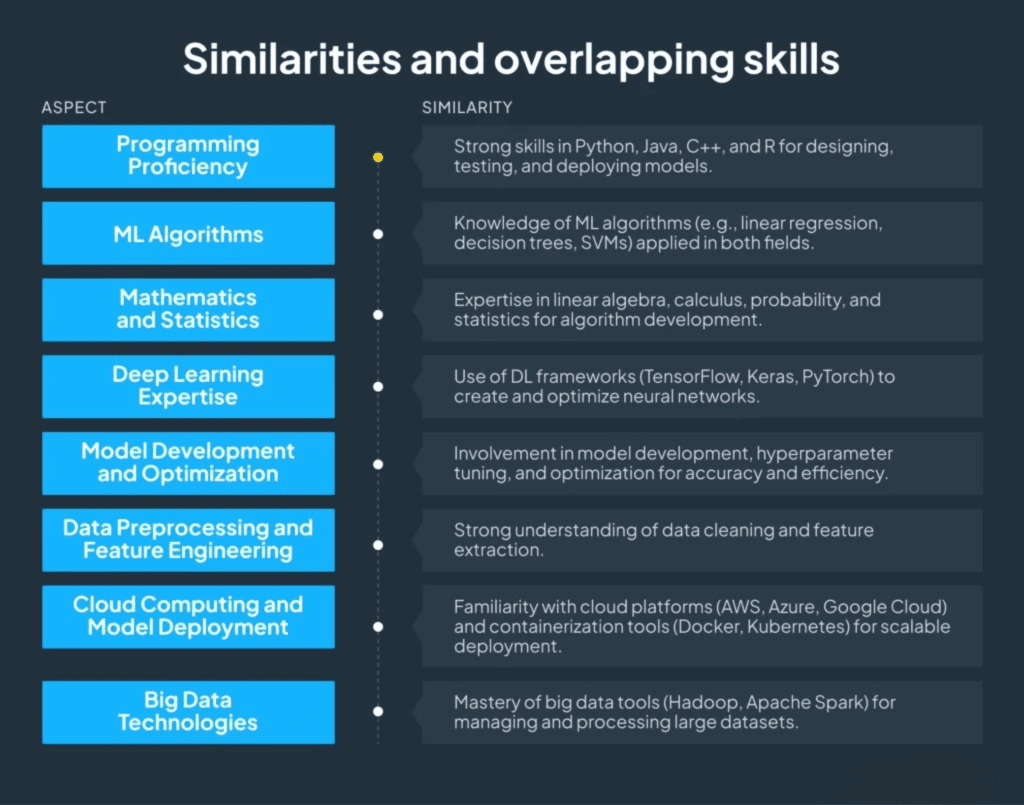
AI/ML-engineer-overlapping-skills

When you’re clear on these three, your hiring process becomes ten times easier. You’ll attract candidates who understand why their work matters, not just what tools to use.

Remember, clarity is the first filter. If you can’t define what you need, even the best AI engineer can’t deliver it.

Step 2: Craft a Job Description That Attracts the Right Candidates

Let’s be honest: most AI/ML job descriptions sound like a grocery list written by ChatGPT.

“Must know Python, TensorFlow, PyTorch, Keras, R, C++, SQL, cloud, and possibly quantum computing.”

The result?

You scare off great engineers and attract people who just copy-paste frameworks into their résumés.

A great job description doesn’t just describe tasks. It sells a mission.

Here’s how to do it right:

1. Lead With Why, Not What

Open with a single line that tells candidates why your company exists and how AI fits into the bigger picture.

For instance,

“We’re building smarter retail experiences using AI-driven demand prediction to help us make shopping effortless.”

Remember, top engineers want purpose, not just perks.

2. Be Specific About the Impact

Instead of vague fluff like “work on exciting AI projects,” write:

“You’ll design and deploy ML models that predict sales trends across 10,000+ SKUs in real time.”

That’s concrete. It shows scale, challenge, and real-world impact.

3. List Skills That Actually Matter

Keep your stack practical and relevant. Here’s what you should ask for:

  • Must-haves: Python, TensorFlow/PyTorch, data preprocessing, model evaluation, MLOps (CI/CD, Docker, AWS/GCP).
  • Nice-to-haves: NLP, time-series analysis, or computer vision depending on your domain.
  • Soft skills: Problem-solving, communication, collaboration, and ownership mindset.

A candidate who can explain a model to your marketing team is more valuable than one who can only tune hyperparameters.

4. Don’t Oversell or Underpay

Avoid phrases like “rockstar” or “AI ninja.” Real engineers hate that.

And if your budget says “intern,” don’t post for a “Senior AI Lead.” It only wastes everyone’s time.

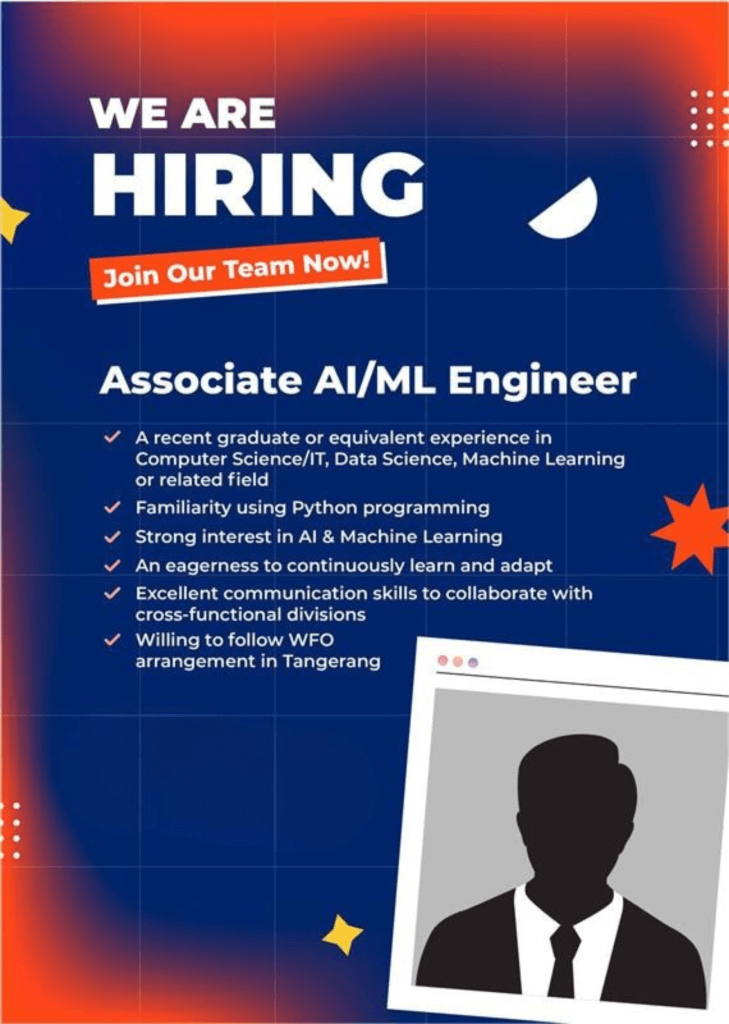
Ai/ML-engineer-hiring-post-sample

5. Include a Quick Note on Your Data

Good engineers care about data quality. Mention what they’ll work with.

For instance, add something like —

“We have structured sales and behavioral data from 1M+ customers, ready for model training and experimentation.”

It signals maturity.

Pro Tip: End your job description with an invitation, not a requirement.

Here’s an example:

“If you’re passionate about turning data into real-world impact, we’d love to talk.”

That single line filters in motivated candidates faster than a 50-question test.

Step 3: Where and How to Source Top AI/ML Engineers

To be frank, posting only on LinkedIn and hoping for magic won’t cut it. The best AI/ML engineers rarely apply through job boards.

They’re too busy solving problems, winning Kaggle competitions, or pushing commits to GitHub at 2 a.m.

So, where do you actually find them?

1. Go Where the Code Lives

GitHub, Kaggle, and Stack Overflow are gold mines. Look for engineers who contribute to open-source ML projects, share notebooks, or have meaningful discussions in forums.

Real engineers leave fingerprints. You just have to follow the trail.

2. Use LinkedIn the Smart Way

Skip the generic “AI Engineer” search. Instead, use Boolean searches like:

“machine learning engineer” AND (“model deployment” OR “MLOps”) AND Python

Filter for candidates who have written about their work, not just listed buzzwords. Check activity, recommendations, and project links.

3. Tap Into Communities, Not Just Platforms

Join Slack groups, Discord channels, and local AI meetups. Many great engineers prefer community collaboration over recruitment portals.

You can also sponsor a data challenge or host a small hackathon. It will get you visibility and interested talent in one shot.

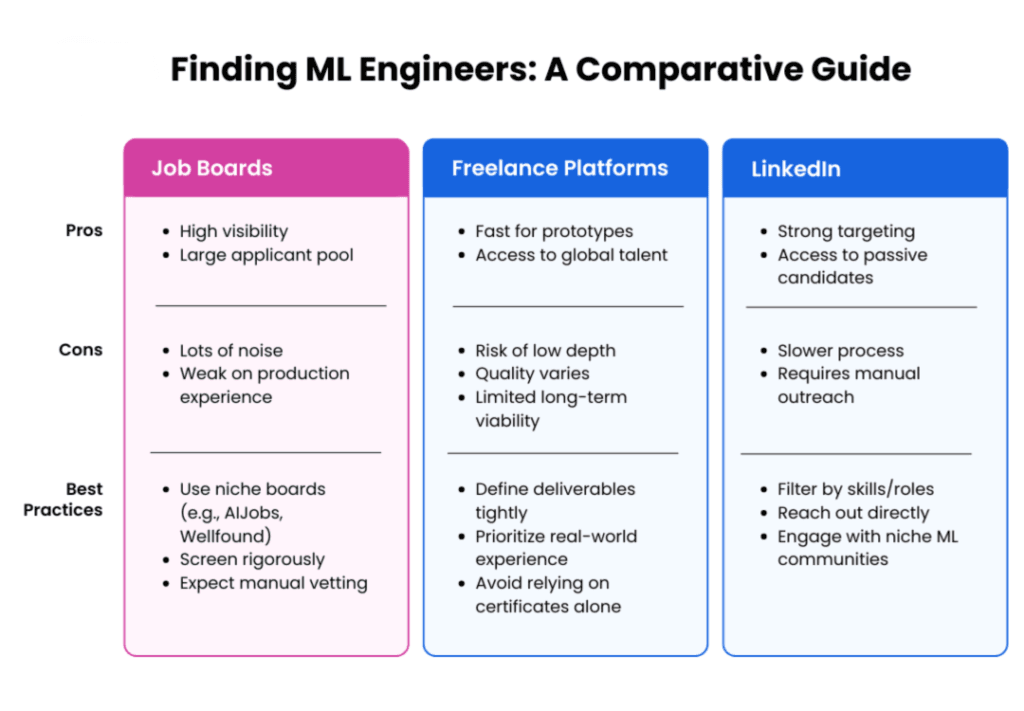
where-to-find-AI/ML-engineers

Also, start networking with potential candidates months before hiring. Comment on their GitHub projects, share their work, or invite them to discuss challenges your team faces.

By the time you’re ready to hire, you’ll already have trust built in.

4. Look Beyond Borders

The best part about AI talent? It’s global.

Hiring remote AI/ML engineers gives you access to top talent without the Silicon Valley price tag. 

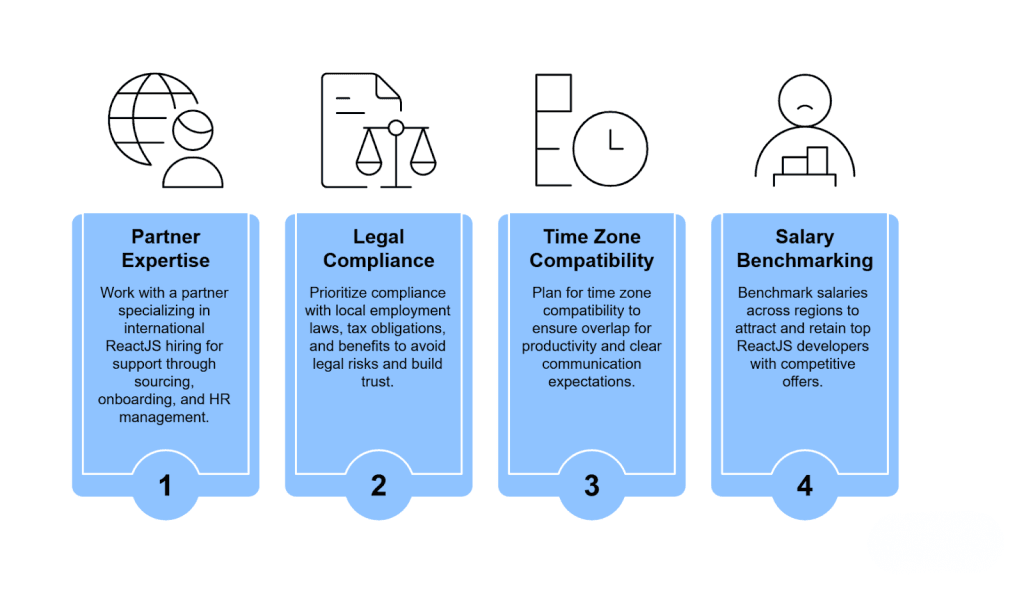
There are a lot of individual AI/ML developers and staff augmentation companies who can give you access to pre-vetted talents that will seamlessly become your extended team, even from the opposite corner of the globe. 

Just make sure you evaluate for time zone overlap, communication skills, and prior remote work experience.

Pro Tip: The strongest candidates are often not looking. They’re open to opportunities that feel meaningful. Don’t only chase resumes, start conversations.

Step 4: Screen Smart, Not Hard

Let’s face it, most AI interviews are broken.

Endless whiteboard math, questions about obscure algorithms, and “how would you build a neural net from scratch?” tests that no one actually does in real life.

You’re not hiring a researcher from OpenAI. You’re hiring someone who can solve real problems with real data.

Here’s how to screen efficiently, without burning your team (or the candidate) out.

1. Start With a Conversation, Not an Exam

Begin with a short call. Ask them to explain a recent project in plain English.

  • What was the goal? 
  • How did they measure success? 
  • What went wrong?

You’ll instantly see who understands end-to-end problem solving versus who just copies notebooks from GitHub.

2. Give Practical Challenges

Forget trick questions. Instead, share a small dataset and a real-world objective.

For example:

“Predict customer churn based on usage data and explain what features you’d prioritize.”

This way, you’ll see their thinking process: how they handle data cleaning, model selection, and trade-offs.

Remember, It’s not about perfection; it’s about reasoning.

Ai/ML-engineer-skills-required

3. Look for Signs of Production Thinking

Many candidates can train models. Few can deploy and maintain them.

So, look for skill-sets beyond flashy CVs. Ask:

  • How would you monitor a model after deployment?
  • What tools do you use for version control or CI/CD?
  • How do you handle model drift?

A good ML engineer talks about pipelines, reproducibility, and monitoring; not just accuracy scores.

4. Evaluate Communication and Collaboration

AI is a team sport. Your engineer will need to work with developers, designers, and product managers.

If they can’t explain a concept like “overfitting” without sounding like a textbook, that’s a red flag.

A great engineer makes complex things simple, not the other way around.

5. Use Peer Review Wisely

Involve your senior data or ML engineers in the screening process. They’ll spot red flags faster than HR ever could. But make sure they evaluate based on relevance, not ego.

You don’t need theoretical perfection, you need practical problem-solvers.

Pro Tip: The best screening process feels like collaboration, not interrogation. If a candidate leaves your interview more excited about your project, you’re doing it right.

Step 5: Conduct Final Interviews that Balance Skill and Fit

By this stage, you’ve filtered out the buzzword warriors. Now it’s time to find out who can actually thrive in your environment.

Because even the smartest AI/ML engineer will fail if they don’t fit your team’s rhythm or understand your business goals.

Here’s how to make the final evaluation count.

1. Go Beyond Technical Mastery

At this stage, assume everyone can code. Now you’re looking for something rarer: judgment.

Ask how they decide when to use a model, not just how to build one.

For Instance, Ask something like this —

“Tell me about a time when you decided not to use AI. What made you change direction?”

This way, you’ll learn who can think strategically and avoid building fancy models for the wrong problems.

2. Test for Curiosity and Clarity

Great AI/ML engineers are lifelong learners.

Ask what new tech or research they’ve been exploring lately and why it matters. 

If they can break down a complex paper in simple terms, you’ve got a communicator, not just a coder.

Pro Tip: Bring in someone from marketing, product, engineering, or design to join the interview. You’ll see how well they adapt their communication style across disciplines.

If your marketing lead can understand their answer, hire them; they’re a keeper. Because in reality, AI projects succeed when data, design, and delivery move in sync.

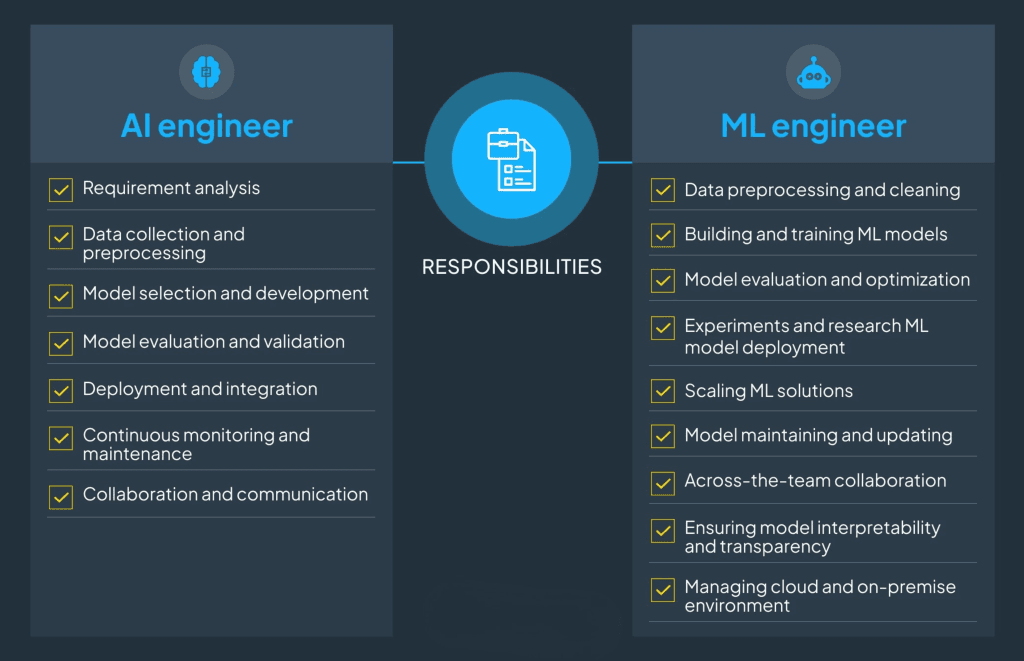
Ai/ML-engineer-job-responsibilities

3. Check for Ownership Mindset

Technical brilliance means little without accountability. You want engineers who don’t just build models, but own them through every stage of the lifecycle.

So, ask questions like:

  • If a deployed model suddenly performs poorly in production, what would you do first?
  • How do you approach a project when requirements or data change midway?

Listen for signs of accountability, not blame. The best engineers take ownership of outcomes, not just output.

Ownership means caring about results, not just releases. 

It’s the difference between an engineer who says, “The model worked fine on my machine,” and one who says, “Let’s fix this for production users.”

Look for candidates who talk in terms of impact and users, not just accuracy metrics. That mindset will save you from 2 a.m. Slack pings, endless blame loops, and “not my job” silos later on.

4. Align on Values and Vision

Before closing the deal, make sure they understand why your company does what it does.

  • Do they resonate with your mission? 
  • Do they get excited talking about your data problems?

People who feel connected to the vision stick longer and deliver better results.

Pro Tip: The best final interview feels less like an evaluation and more like a strategy session. If you walk away thinking, “I’d love to build with this person,” you’ve probably found your hire.

Budgeting for Brilliance: How to Plan (and Not Panic) When Hiring AI/ML Talent

Let’s be real: hiring great AI/ML engineers isn’t cheap.

But hiring the wrong one? That’s how budgets implode faster than a misconfigured AWS bill.

So, before you start throwing salary numbers into the wind, let’s talk about what actually drives cost, and how to budget smart without cutting corners.

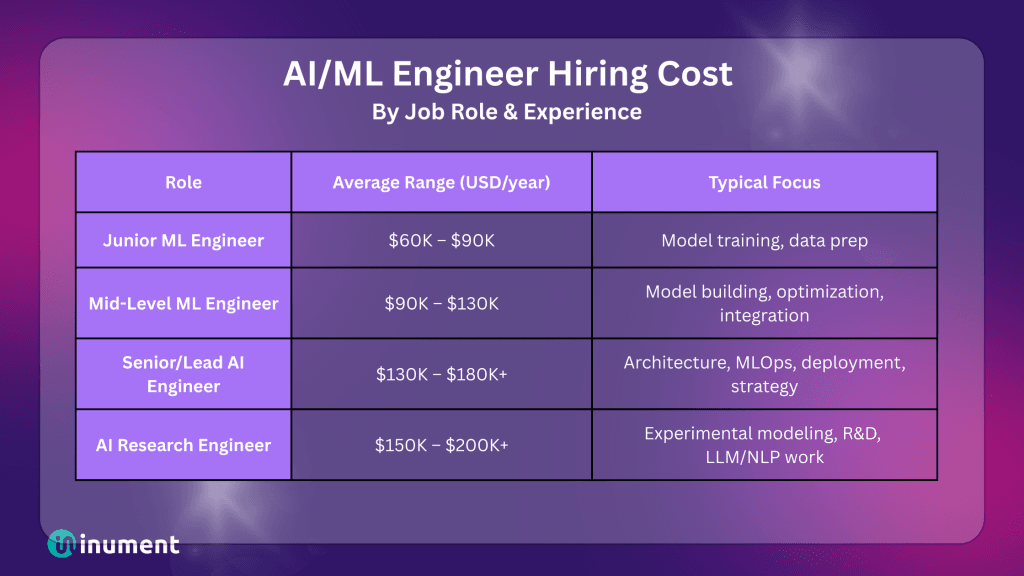
1. Know What You’re Paying For

AI/ML engineers come in many flavors, and so do their price tags.

Of course, these vary wildly by region. A senior engineer in Eastern Europe or South Asia might deliver the same quality for half the cost of a Silicon Valley hire.

2. Factor in the Hidden Costs

Beyond salaries, there’s infrastructure, cloud costs, and tools. Training large models on GPU-heavy environments can rack up expenses faster than you think.

Don’t forget time: bad hires cost months in delays and retraining. So investing upfront in a thorough hiring process actually saves money later.

3. Balance In-House and Offshore Talent

Startups often benefit from a mixed teams: a lean in-house/nearshore core team supported by seasoned offshore AI/ML engineers.

Although these two models are completely different, this hybrid approach cuts costs while keeping strategic control in-house.

Enterprises, on the other hand, can scale faster through staff augmentation: bringing in specialized engineers for high-impact projects without long-term overhead.

Smart budgeting isn’t about finding the cheapest option. It’s about blending skill, scalability, and sustainability.

4. Pay for Impact, Not Hype

Avoid being dazzled by titles or degrees. A self-taught engineer who’s deployed production-ready models might outperform a PhD who’s never shipped a line of code.

Focus your budget on proven outcomes, not theoretical potential. So rather than asking for publications, evaluate solid portfolios.

5. Build a Long-Term View

AI is not a one-time investment, it’s a capability. Plan for continuous improvement, retraining models, and evolving infrastructure. 

The engineers you hire today will shape how adaptive and scalable your AI systems become tomorrow.

Also, don’t forget about post-deployment realities (MLOps, scaling, maintenance). Remember, treat AI hiring like product investment. You’re not just buying skills; you’re building future velocity.

Common Pitfalls to Avoid When Hiring AI/ML Engineers

Hiring AI/ML engineers can feel like navigating a maze blindfolded. You think you’ve found a genius… until they spend six months fine-tuning a model no one needs.

The truth is, most bad hires aren’t bad people. They’re just mismatched for the problem, the process, or the pace.

Here’s how to stay out of the usual traps, and how to sidestep them:

  • Hire for purpose, not hype — Don’t chase buzzwords. Define your business goal first, then find the skillset that fits it. “Let’s bring in AI and see what happens” never ends well. Start with a roadmap and measurable objectives.
  • Don’t confuse research with delivery — A strong academic background doesn’t guarantee shipping results. Look for engineers who’ve deployed models in production.
  • Never ignore the data reality — Your data is never as clean as your ambitions. Hire people who’ve worked with messy, real-world datasets.
  • Avoid over-engineering simple problems — Not every task needs deep learning. Choose engineers who prioritize ROI over model complexity.
  • Keep a sharp eye on communication — AI needs translators, not just coders. Pick candidates who can explain models to non-technical teams.
  • Don’t Forget culture fit — Even great engineers fail in the wrong environment. Match technical depth with your team’s pace and workflow.
  • Deployment know-how is a must — If they’ve never touched MLOps or cloud infrastructure, expect scaling headaches. Verify end-to-end experience for technical evaluation.
  • Don’t neglect post-hire setup — Even top engineers need context. Provide clean data, clear goals, and collaboration channels from day one.

A single bad hire can drain budgets, delay releases, and erode trust in your AI strategy. Bad hires can break models faster than you can say “overfitting.”

That’s why hiring right isn’t about speed, it’s about alignment.

This is exactly why Inument has helped companies avoid these pitfalls by aligning technical talent with product vision and operational goals. 

We focus on matching engineers who not only build models but understand why they matter; so your data works harder, smarter, and faster.

Wrapping Up: Turning Data into Direction Starts with the Right People

It’s true that AI is changing the future of technology and business. But, AI success isn’t just about the algorithms you use. It’s about the people who build, refine, and adapt them to your business reality.

A skilled AI/ML engineer doesn’t just write code; they interpret your data, challenge assumptions, and translate chaos into clarity. They connect models to meaning, and meaning to measurable growth.

When you hire right, AI becomes more than a buzzword. It becomes a force multiplier. Your models get smarter. Your decisions get faster. 

Your systems get leaner. But it starts with clarity: knowing what you need, defining outcomes, and bringing in people who can turn raw data into direction.

At Inument, we’ve seen how the right engineers transform organizations from data-rich to data-driven. Not through flashy tech, but through thoughtful engineering, strong collaboration, and business-aligned problem solving.

So before you rush to hire, pause to align. The right people don’t just understand your data. They also understand your vision, and make it real.

Ready to find the AI/ML engineers who can turn your data into results?

Let’s connect and explore how you can build a team that actually delivers impact: fast, focused, and future-ready!

About the Author

admin

admin

Want to Build Your Dream Tech Team? Hire Now!

Smart Strategies for Hiring Top-Tier Tech Staff in Singapore

Smart Strategies for Hiring Top-Tier Tech Staff in Singapore

17 December 2025

|

IconInument

Icon Icon Icon
Hire-tech-staff-in-singapore

Hiring the right developer in Singapore sounds simple until you actually try it. 

In a market where every startup at One North is fighting for the same engineers as the big boys in Marina Bay, finding someone who can actually deliver is harder than choosing the right chicken rice stall at Maxwell!

Whether you run a lean startup in Block 71 or an enterprise team in the CBD, the quality of your tech staff decides how quickly you can build, adapt, and stay competitive.

Hiring great developers is the difference between shipping a fast, secure product and spending your nights debugging production issues with iced kopi at 2 a.m. 

A bad hire hurts more than people admit. Missed deadlines, sloppy code, broken features, and a team that quietly loses confidence. Budget balloons. Morale dips. 

To help you navigate this maze, this article aims to give you a clear, practical look at how to avoid those costly mistakes, how to hire top tier tech staff in Singapore that actually strengthens your team, and a few reality checks along the way.

You will see why local hiring feels challenging, how to spot the early signs of a mismatch, and what smart founders in Singapore are doing to build a high performing engineering team without breaking their budget or sanity.

Without any further ado, let’s jump right in!

Why Great Tech Talent Matters in Singapore

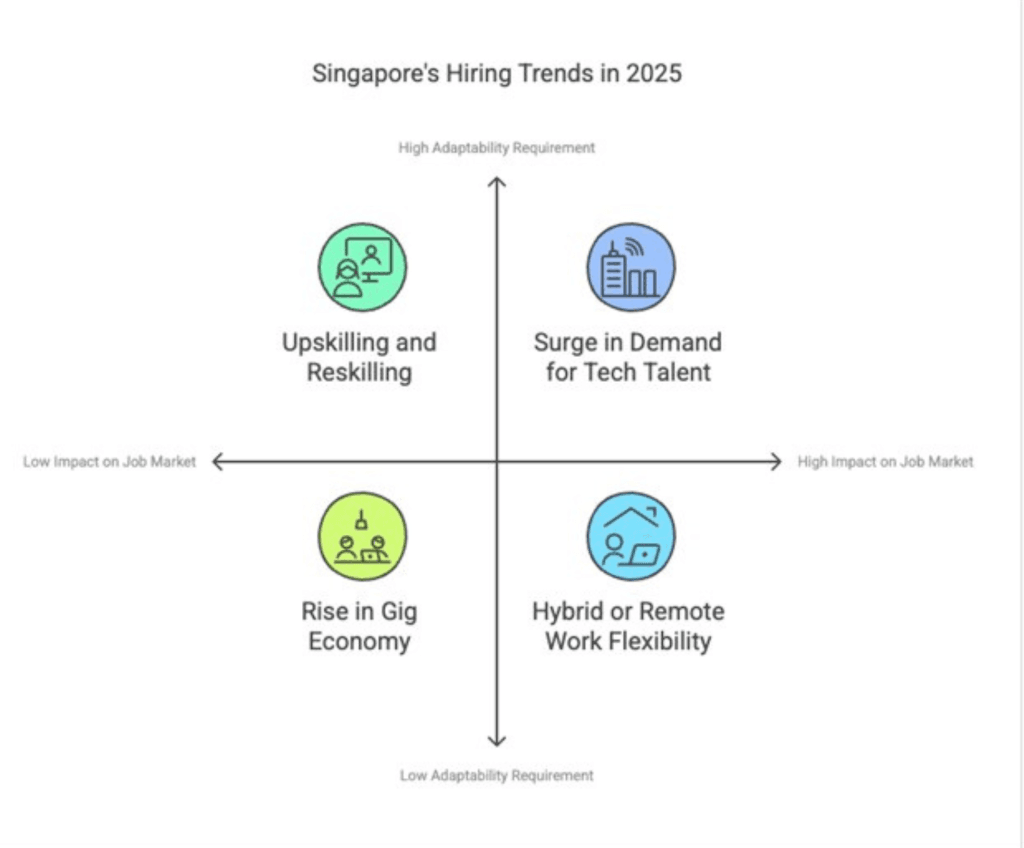
Great developers matter everywhere, but in Singapore it hits differently. Hiring tech talent in Singapore feels like competing with Big Tech on “hardcore mode”.

Whether you want to launch new features, modernize your legacy systems without breaking compliance, or ensure security while still shipping updates on time; you’ll need reliable tech talent that can comfortably juggle multiple hats. 

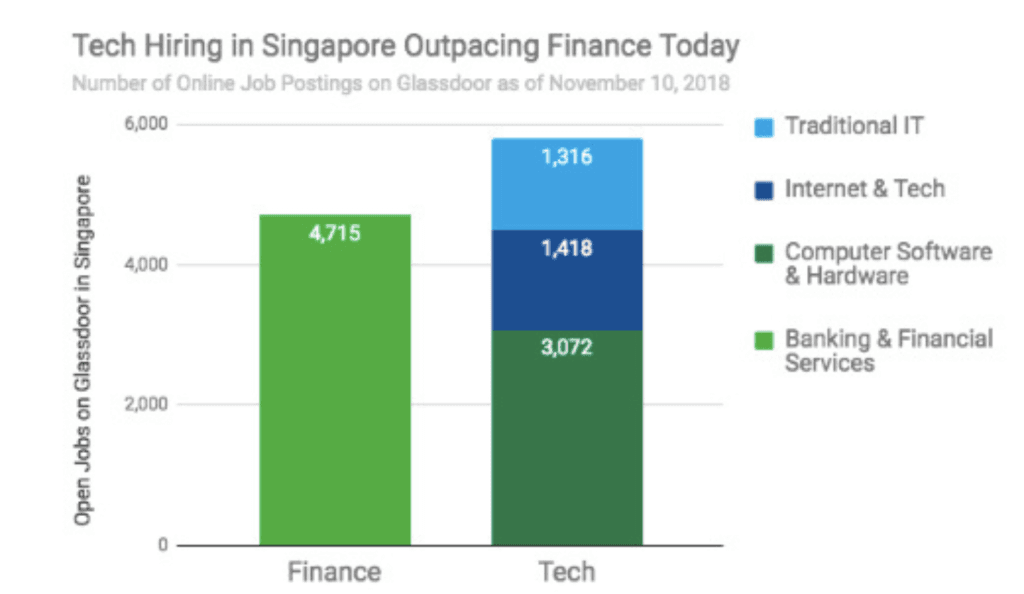
tech-hiring-in-singapore


Every sector relies on developers who can write clean code, solve problems without drama, and work well in hybrid teams spread across Singapore, Malaysia, and the region.

Strong engineers shorten your release cycles, keep your platform stable, and help you innovate without turning your system into a fragile mess. 

They also make onboarding easier, reduce downtime, and lift the quality bar for everyone on the team. 

Ultimately, when you hire well —

  • Your product feels smoother, 
  • Your users stay longer, and 
  • Your team stops firefighting long enough to build something meaningful.

The reverse is especially painful here. Singapore is small, the market is competitive, and a single shaky engineer can slow your entire roadmap. 

If your developers are slow, careless, or constantly stuck, your product will feel it immediately. In a market as tight as Singapore, slow execution hurts more than anything else.

That’s why hiring top tier talent isn’t just nice-to-have. It is how you maintain speed, reliability, and reputation in one of Asia’s fastest moving tech hubs.

The Hidden Cost of a Bad Tech Hire

A bad tech hire feels cheap at first, then quietly becomes the most expensive line item in your roadmap. They rarely look dangerous on day one. 

Everything seems okay, they say the right things, and convince yourself that the gaps you noticed will “sort themselves out”. 

But in Singapore’s fast moving tech scene, that tiny doubt can grow into a full blown operational headache even faster than you can finish your second kopi of the day.

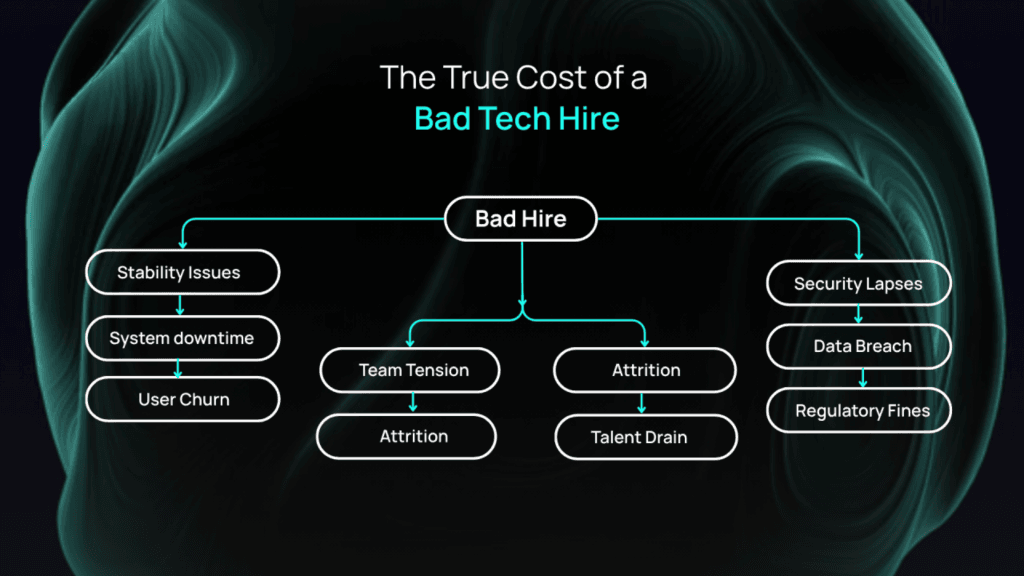
Here’s the honest truth: A weak engineer doesn’t just write bad code. They slow everything around them.

  1. Your sprints drag. 
  2. Senior devs quietly start doing double work.
  3. Managers get pulled into unnecessary reviews.
  4. Features that used to run smoothly break at the worst possible time. 
  5. Your product accumulates technical debt faster than you can clear it.

The End Result? You begin spending more hours fixing yesterday’s issues than building tomorrow’s product. It feels small at first, then suddenly your entire roadmap is off by a month, or even more!

And the bill for this always piles up. You lose time, money, and momentum. Instead of shipping an MVP that impresses investors, you end up patching bugs that should never have existed. 

Instead of preparing a major release for your enterprise clients, your team is stuck debating why the API integration failed again. It is not just inefficient. It is demoralizing.

true-cost-of-a-bad-tech-hire


Another part founders rarely talk about is the morale drop. Good engineers hate cleaning up avoidable messes. They get frustrated, they lose trust, and  soon your best people start updating their LinkedIn profiles.

This is why Singapore founders and CTOs need a sharper hiring process. Not stricter, just smarter. The right filters, realistic expectations, short project based tests, and clear communication can save you from months of damage control.

The fix is simpler than you think. Stop panic-hiring. Slow down just enough to define the role clearly, run a focused practical test, and check how candidates think, not just what they claim on paper. 

A bit of structure saves you from months of cleanup later.

Smart Hiring Strategies That Actually Work in Singapore

Smart hiring in Singapore is less about luck and more about using the right playbook. 

With every company from fintech firms to AI startups fighting for the same pool of engineers, you cannot afford a hiring process built on gut feeling and kopi shop optimism. 

You need strategies that cut through noise, reduce guesswork, and help you spot real talent before someone else snaps them up.

The good news is that effective hiring does not require complicated frameworks or endless interview rounds. A few targeted, practical steps can help you find developers who actually deliver, communicate well, and fit your team without creating drama. 

Now let’s break down the strategies that work, especially for Singapore startups and enterprises who want strong engineers without burning their runway. 

Here are some best practices for hiring tech talent in Singapore we recommend our clients:

1. Define Roles Around Outcomes, Not Buzzwords

Most Singapore founders make the same mistake when hiring developers. They write job descriptions packed with tools, frameworks, and every buzzword they have seen on LinkedIn. 

The result looks impressive, but it attracts the wrong crowd. You get applicants who know the keywords, not the work.

A smarter approach is to define the role based on outcomes. 

Ask yourself: What do you actually need this engineer to achieve in the next three to six months?

  • Ship an MVP? 
  • Stabilize a legacy system? 
  • Improve page load speed so your users are not abandoning the app halfway through a transaction?

Each outcome demands a different skill profile.

When you anchor the role to real business goals, the must haves and nice to haves fall into place on their own. 

If you are building a fast moving MVP in One North, you want someone who can make decisions quickly, prototype without drama, and work across the stack. 

If you are hiring for an enterprise platform in Marina Bay, you need a developer who values stability, documentation, and long term maintainability.

This shift sounds simple, but it changes who applies and who stands out. You stop chasing “unicorns” and start attracting engineers who know how to deliver impact in real conditions. 

And in a competitive market like Singapore, clarity is your first tactical advantage.

2. Keep the Interview Process Lean and Real

A bloated interview process is one of the fastest ways to lose good candidates in Singapore. Engineers here have options, and if your hiring flow feels longer than the queue at Tiong Bahru Bakery on a Sunday morning, they will quietly disappear.

A lean, realistic process respects everyone’s time and gives you clearer signals. Skip the academic puzzles and trick questions that no one uses outside a coding bootcamp. 

Instead, test candidates with the kind of work they will actually do on your team. 

For instance,

  • A small UI tweak. 
  • A backend endpoint. 
  • A debugging exercise. or
  • A short refactor.

Thirty minutes of real tasks will tell you more than three rounds of theory.

Pay close attention to how they explain their decisions. In Singapore’s hybrid teams, communication is not optional. You want someone who can break down complex problems clearly, collaborate across Slack and Jira without confusion, and hold their own in discussions with designers, PMs, and DevOps.

Also move fast. If you find someone strong, do not let them sit in limbo while you gather everyone for a “final alignment meeting”. The best engineers are off the market quicker than a Nasi Lemak set disappearing at 8 a.m.

A simple, practical interview process helps you see real ability, avoids time wasting, and shows candidates that your team values clarity and efficiency. And in Singapore’s talent market, that is how you stay competitive.

3. Use Tech Staff Augmentation Wisely

In Singapore, IT staff augmentation is not a shortcut. It is a strategy. When used well, it gives startups and enterprises the flexibility to scale fast without lowering their standards or blowing their budget at Raffles Place. 

On the flip side, use it poorly and it becomes the hiring version of ordering mala at level 10 heat, thinking you can handle it, and regretting everything five minutes later.

The key is knowing when augmentation actually makes sense, and when it doesn’t. 

If your in-house team is stretched thin, if you are racing toward a release, or if you need niche skills like DevOps or AI engineering that are hard to find locally, a strong augmentation partner can save you months of hiring cycles. 

You get experienced engineers who can integrate into your workflow, follow your processes, and deliver without the usual onboarding drag.

But here is where many Singapore founders slip: They treat augmentation like outsourcing.

  • Random rotating developers, 
  • No ownership, 
  • No stability, and 
  • No visibility.

That is how projects go sideways fast.

The smart move is choosing a partner (Like Inument) that provides dedicated engineers, not a revolving bench. You want people who become part of your daily standups, collaborate with your team, and stay long enough to understand your product deeply. 

Clear overlap hours, strong communication habits, and consistent delivery should be non negotiable.

Used correctly, staff augmentation does more than fill headcount. It gives you breathing room, reduces hiring risk, and keeps your engineering momentum steady even when local hiring gets tough. 

It is how many Singapore companies scale without burning out their core team or waiting endlessly for “the perfect hire” to appear on LinkedIn.

Smart Budgeting Without Breaking Quality

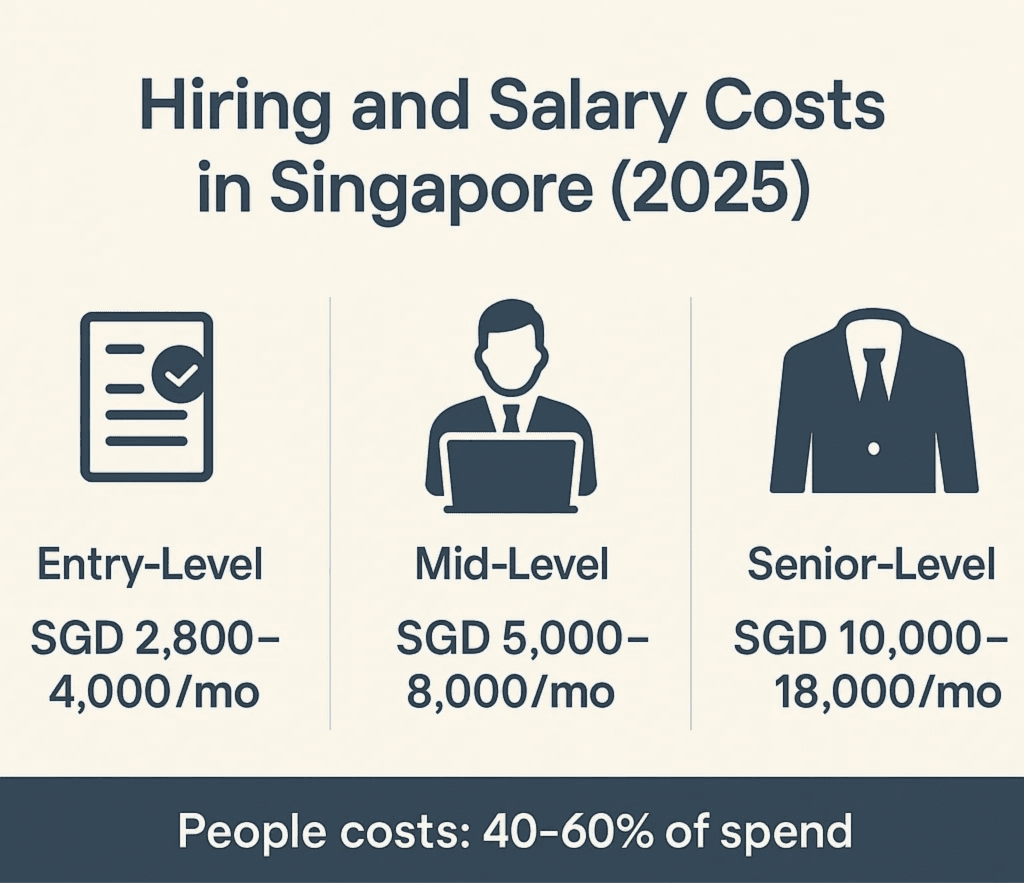
Hiring tech talent is expensive, and every founder eventually feels the tension between staying within budget and hiring someone who can actually deliver. 

If you chase the lowest cost, you often end up paying more later in rewrites, missed deadlines, and technical debt that drags down your entire roadmap. 

If you overspend, on the other hand; you burn the runway faster than your product can grow.

The goal is not to hire cheap, it’s to hire smart. You want a budgeting approach that protects quality without stretching your financial limits. 

It starts by understanding the difference between cost and value. A strong engineer who ships clean, reliable work saves you weeks. A weak hire creates months of overhead.

Let’s break down how to budget wisely without compromising the talent you bring in: 

  1. Hire for outcomes, not tool lists. Define what the engineer must deliver in the next 90 days, then match skills to that.
  2. Test real work, not puzzles. A small practical task reveals more than any algorithm quiz.
  3. Avoid inflated JDs. Asking for ten unrelated skills attracts noise, not talent.
  4. Validate experience through code. Portfolios, repos, and past projects tell the truth.
  5. Do not skip communication and culture fit. Even one misaligned hire can slow the entire team.
  6. Prioritize ownership mindset. You want someone who takes responsibility, not someone who waits for instructions.
  7. Use staff augmentation to fill skill gaps, not to outsource accountability.
  8. Start with a small scope before committing long term. It reduces risk and confirms capability.
  9. Document your hiring process. It reduces bias and keeps decision making consistent.
  10. Review your hires every six months. It keeps standards high and performance issues visible early.

These tips are simple, but they cut through the noise. 

Hiring strong tech talent is never about luck. It is about clarity, discipline, and choosing the signals that actually matter. 

When you apply these habits consistently, you reduce risk, shorten hiring cycles, and build a team that moves with confidence instead of hesitation. 

Remember, strong engineers are not found by chance. They are found through a process that respects both your standards and your roadmap.

How to Recover From a Wrong Hire

Recovering from a wrong hire is never pleasant, but it is a lot easier when you face the issue early instead of hoping it magically improves. 

Every team, at some point, ends up with someone who looked great on paper but struggles when the real work begins. The good news is that a bad hire does not have to derail your entire roadmap.

Start by assessing the impact honestly. Identify what is slipping. Is it code quality, communication, delivery speed, or ownership? 

Clarity matters, because it tells you whether the problem can be corrected with guidance or whether it is a deeper mismatch.

How-to-recover-from-a-bad-hire


If improvement is possible, set clear expectations. Give the developer a focused plan with specific goals and timelines. Keep it measurable. Small course corrections work best when they are simple and direct.

If the gap is too wide, do not drag the process out. Prolonging a mismatch drains your team, slows progress, and frustrates your stronger engineers. It is better to make a clean decision and course correct quickly.

While you fix the issue, strengthen the rest of your team. Reassign critical tasks to your reliable engineers, bring in short term support if needed, and keep your roadmap stable. Pairing your team with experienced augmented engineers can help you recover lost momentum without adding long term overhead.

A wrong hire is not a failure. It is a signal that your hiring process needs a slight adjustment. Handle it early, handle it clearly, and you will regain speed faster than you expect.

How to Recover From a Wrong Hire

Hiring in Singapore’s fast moving tech market is tough, and many founders eventually realize they need a partner who actually understands engineering, team dynamics, and the realities of building products under pressure. That is where Inument makes the difference.

Inument gives companies access to vetted engineers who deliver real value from day one. Each candidate is evaluated for practical skill, code quality, communication, and their ability to work within modern engineering workflows. 

No guesswork, no inflated résumés, and no surprises halfway through a sprint.

Most Singapore teams use Inument for three reasons:

  • They want predictable quality. 
  • They want speed without hiring chaos, and 
  • They want engineers who raise the standard instead of creating more work.

Inument delivers all three by giving you dedicated talent, clear overlap hours, and steady delivery that supports your long term goals.

Our engineers integrate into your team smoothly, join your standups, adapt to your tools, and maintain a steady delivery rhythm. You avoid the churn of constant rehiring and the drag of onboarding someone who cannot keep up.

You also gain flexibility. Whether you need one senior engineer to stabilise your platform or an extended team to accelerate your roadmap, Inument integrates seamlessly with your existing processes. 

For tech leaders who want to scale confidently, Inument is the partner that turns hiring from a constant struggle into a strategic advantage.

Wrapping Up: Your Next Step Toward Smarter Tech Hiring

Getting tech hiring right in Singapore is tricky. Salaries are high, talent gaps are real, and everyone claims to know React, Node, and Kubernetes until you ask them to build something that works outside a tutorial.

However, hiring well is not about being picky. It is about protecting your product, your team, and your runway from problems that are far easier to prevent than to fix later.

When you define roles around real outcomes, keep your interview process practical, and avoid panic hiring, you set your engineering team up for long term success. 

When you budget with intention and use staff augmentation strategically, you gain the flexibility to scale without compromising quality.

The truth is simple: Strong engineers make everything easier. Weak hires make everything harder. 

Ready to find the right talent? Let Inument help you build your dream team, without the stress.

Smarter hiring starts with one conversation. Let’s build your next engineering win together!

About the author

admin

admin

Want to Build Your Dream Tech Team? Hire Now!

Nearshore vs Offshore Outsourcing: How to Make the Best Choice for Your Business

Nearshore vs Offshore Outsourcing: How to Make the Best Choice for Your Business

10 December 2025

|

IconInument

Icon Icon Icon
Nearshore-vs-offshore-outsourcing

When it comes to software development, outsourcing isn’t just a cost-cutting tactic anymore. It has become a smart way for businesses to scale faster and access specialized expertise without breaking the bank.

But here’s the million-dollar question: when you’re ready to outsource, should you go nearshore or offshore?

Both approaches offer distinct advantages and challenges, and choosing the best option for your business requires understanding your unique needs, project requirements, and budgetary constraints.

In this blog, we’re going to break down the key differences between nearshore and offshore outsourcing, and weigh their pros and cons. 

Our goal is to help you determine which model will give your business the best return on investment while ensuring smooth, high-quality project execution.

Let’s dive right in!

What is Nearshore Outsourcing?

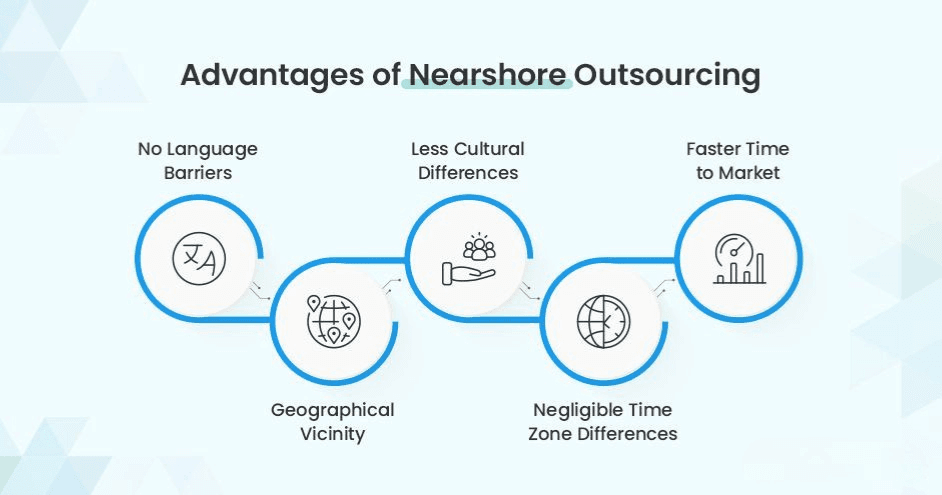
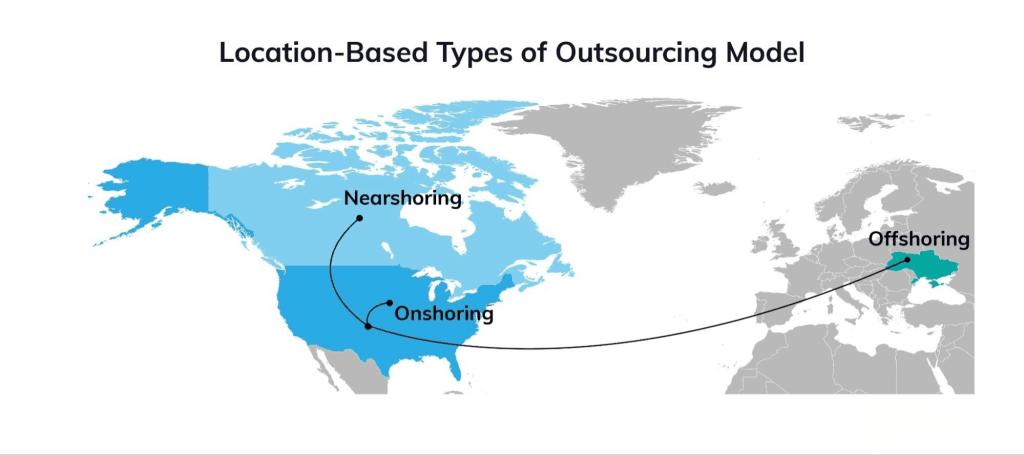
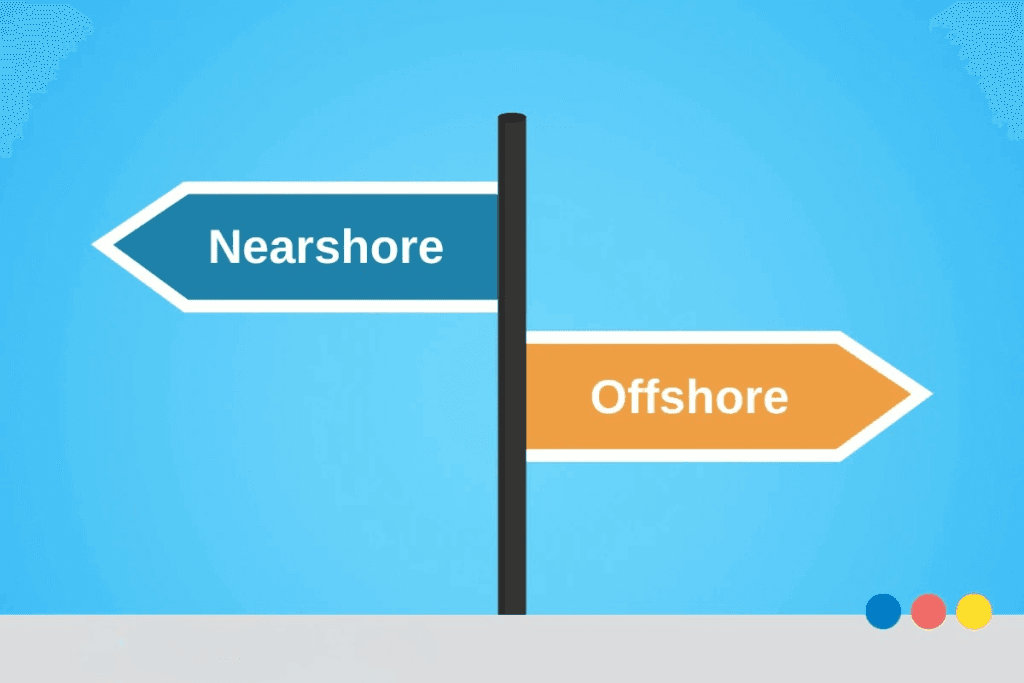
Nearshore outsourcing is all about teaming up with companies or talent in nearby countries, usually within the same time zone or just a few hours apart.

The big difference from offshore outsourcing? Proximity. 

Instead of working with teams halfway across the globe (like in Asia), nearshore partners are close enough to make collaboration and communication feel seamless. 

This results in fewer time zone headaches, fewer cultural gaps, and quicker responses.

Nearshore-outsourcing-advantages


For example, U.S. businesses often look to Latin America for nearshore partnerships, while Western European companies typically tap into talent in Eastern Europe.

The primary benefits of nearshore outsourcing include:

  • Time zone alignment: One of the biggest perks of nearshore outsourcing is working in sync. Since nearshore teams usually share your business hours, real-time collaboration and quick feedback become effortless.
  • Cost-effectiveness: Nearshore outsourcing may not be as inexpensive as offshore, but it strikes a sweet spot. You save compared to hiring locally while avoiding some of the hidden costs and friction that can come with offshore teams.
  • Cultural compatibility: Being geographically closer often means shared work cultures, better language fluency, and similar business practices; all of which make projects run smoother.

In short, nearshore outsourcing allows businesses to capitalize on the benefits of international outsourcing while minimizing the typical barriers like language barriers and significant time zone differences.

It provides an ideal middle ground, especially when rapid, efficient communication is critical.

Pros of Nearshore Outsourcing

  • Since nearshore teams are located in similar or adjacent time zones, you can expect real-time communication, easier scheduling for meetings, and quicker turnaround times.
  • Cultural alignment is another huge plus. Nearshore teams often share similar business practices and have strong language proficiency, which cuts down on miscommunication and helps them better understand your market and customers.
  • While nearshore outsourcing can cost more than offshore options, it’s still significantly more budget-friendly than hiring locally; especially when you’re after top-tier talent.
  • And if you ever need to meet in person? Travel is simple and affordable. Whether it’s a project kickoff, an in-depth workshop, or handling something urgent, you can be face-to-face with your team on short notice.
  • Nearshore teams are often familiar with your industry and tools inside out. This means they can plug into your processes quickly, minimizing onboarding time and getting productive right away.

Cons of Nearshore Outsourcing

  • While nearshore regions offer access to high-quality talent, they may not have as large a talent pool as offshore regions like India or Southeast Asia. Depending on your needs, that could limit your options a bit.
  • While nearshore outsourcing offers a cost-effective option compared to hiring locally, it is generally still more expensive than offshore outsourcing.
  • Cultural alignment is a big advantage, but no partnership is perfect. There can still be subtle differences in work styles, business practices, or even legal frameworks that you’ll need to navigate.
  • And like with any outsourced team, nearshore partners may not feel as fully ingrained in your company culture as your in-house staff. Building that connection takes a little extra effort.

What is Offshore Outsourcing?

Offshore outsourcing is when you partner with teams or companies located much farther away (often in completely different continents) to handle your development or business services.

The biggest draw? Cost savings.

Countries like India, China, Southeast Asia, and parts of Eastern Europe offer skilled talent at a fraction of the price you’d pay in Western markets, making offshore outsourcing an attractive option for budget-conscious businesses.

In fact, most US businesses (66% of them) outsource at least one department, and the majority of them depend on the offshoring model to slash operational cost. 

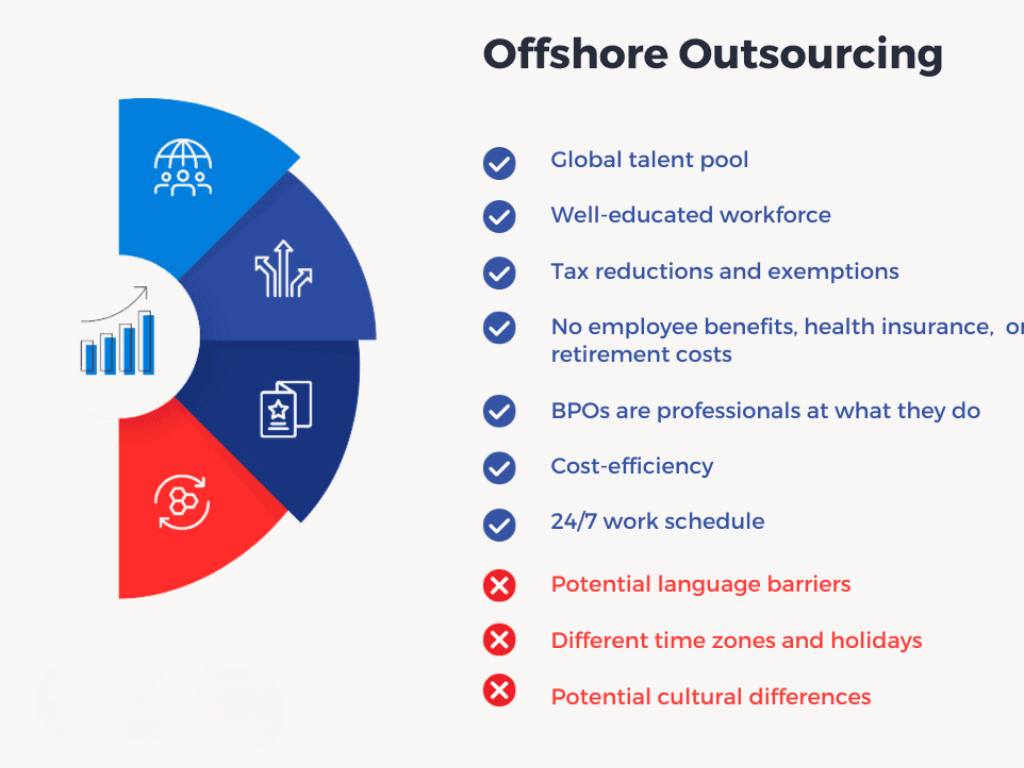
Offshore-outsourcing-pros-and-cons


Beyond saving money, going offshore also opens the door to massive global talent pools. 

You can tap into specialized expertise that might be hard, or even impossible, to find locally. This gives your projects a serious competitive edge.

Some of the main advantages of offshore outsourcing include:

  • Lower labor costs: One of the biggest perks of offshore outsourcing is getting access to top-tier talent at a fraction of the cost of hiring domestically.
  • Access to a wider talent pool: Offshore teams let you tap into global expertise. Whether it’s AI, software development, or niche technical consulting that might be hard to find in your own market.
  • 24/7 productivity: Different time zones can actually work to your advantage. With a “follow-the-sun” model, your projects can move forward around the clock, cutting down development timelines and keeping things moving even while you sleep.

Of course, offshore outsourcing isn’t without its challenges. The distance can sometimes work against you, bringing time zone hurdles, language barriers, and cultural differences into the mix.

These factors can lead to miscommunication or delays if coordination isn’t handled carefully.

In essence, offshore outsourcing provides businesses with an opportunity to tap into global expertise at a lower cost. 

However, careful management and clear communication are essential to overcoming the challenges that come with it.

Pros of Offshore Outsourcing

  • The biggest win with offshore outsourcing is the huge cut in labor costs. Countries like India, the Philippines, and Southeast Asia offer highly skilled professionals at a fraction of what you’d pay for local hires, making it a budget-friendly way to scale.
  • Another major advantage is access to a massive talent pool. Whether you’re looking for AI specialists, full-stack developers, or niche technical experts, offshore markets often have the kind of skills that are hard to find locally.
  • Different time zones can actually work in your favor here. With a follow-the-sun setup, your projects keep moving 24/7, helping you hit deadlines faster.
  • On top of that, offshore teams give you the flexibility to scale up or down as needed. Need extra hands for a big launch? Or want to cut back during slower periods? Offshore resources make that adjustment seamless.

Cons of Offshore Outsourcing

  • One of the toughest parts of offshore outsourcing is the time gap. While the follow-the-sun model can keep projects moving 24/7, that 10–12 hour difference can make real-time collaboration tricky.
  • Language can also be a hurdle. Even with strong English proficiency in many regions, subtle barriers can still creep in and impact communication.
  • Managing offshore teams requires extra care, too. The physical distance and limited overlap in working hours can make it harder to maintain direct oversight, which sometimes leads to missed deadlines or misaligned priorities if not handled well.
  • And then there’s the question of data security. Working with teams in countries that have different privacy laws or compliance regulations can raise concerns about protecting sensitive information and intellectual property.

In short, Offshore outsourcing provides significant cost savings, access to large talent pools, and the ability to scale quickly.

However, it also introduces challenges like time zone misalignments, language barriers, and security risks. 

Deciding whether offshore outsourcing is the right choice for your business depends on the balance between costs, team alignment, and project complexity.

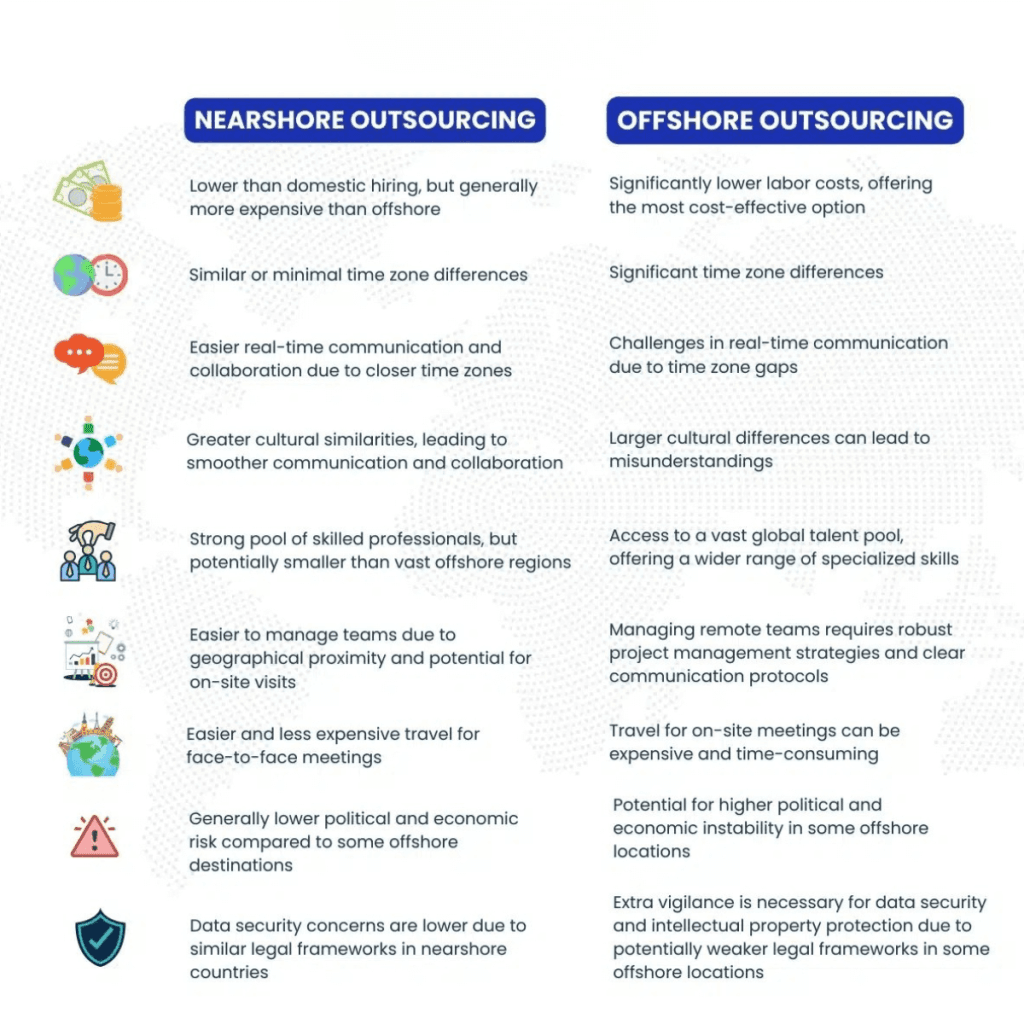
Nearshore-vs-offshore-outsourcing-pros-and-cons

Key Differences Between Nearshore and Offshore Outsourcing

Deciding between nearshore and offshore outsourcing isn’t always straightforward.

Both come with their own benefits, and the best fit really depends on your project’s complexity, budget, and how much real-time collaboration you need.

To make things clearer, let’s break down the key differences between these two models so you can figure out which one aligns best with your business goals:

1. Geographical Proximity & Time Zone Compatibility

With nearshore outsourcing, your teams are based in neighboring countries, usually sharing the same or similar time zones. That means real-time collaboration is a breeze: fewer delays, smoother communication, and easier scheduling.

Offshore outsourcing, on the other hand, often involves teams in far-off regions like India or the Philippines.

That 8–12 hour time difference can make instant collaboration a challenge and may require you to adapt to more asynchronous workflows to keep things moving.

2. Language & Cultural Alignment

One of the big perks of nearshore outsourcing is cultural alignment. Teams in regions like Latin America or Eastern Europe often have strong English skills and similar work practices to those in the U.S. or Western Europe.

That shared understanding makes communication smoother and reduces the risk of things getting lost in translation.

Offshore teams, however, can sometimes face more noticeable language or cultural gaps. 

While many are highly skilled, differences in communication styles or lower language proficiency can create misunderstandings, especially when dealing with complex, detail-heavy projects.

3. Cost Implications

Nearshore outsourcing usually hits a middle ground when it comes to cost. It’s more affordable than hiring locally but pricier than offshore.

What you’re really paying for here is the balance: lower costs combined with smoother communication and faster turnaround times.

Offshore outsourcing, on the other hand, is often the most budget-friendly option. 

Labor costs in regions like India, China, and Southeast Asia are significantly lower, making it a go-to for companies focused on cutting expenses.

The trade-off? Those savings can sometimes come with added challenges around communication and coordination due to distance and time zones.

4. Speed of Delivery

Nearshore outsourcing really shines when it comes to speed and teamwork. With shared time zones, cultural alignment, and easy communication, you get faster delivery and smoother collaboration.

Real-time meetings and quick responses help projects stay on track and move forward efficiently.

Offshore outsourcing can save you a lot on costs, but timelines can sometimes stretch due to time zone gaps and slower feedback loops.

The “follow-the-sun” model keeps work going 24/7, but without real-time communication, small delays in updates or approvals can add up.

5. Talent Pool and Expertise

Nearshore outsourcing connects you with a skilled talent pool that often understands your market and industry-specific challenges. 

The pool might be smaller than offshore, but it’s typically more focused and specialized, making onboarding smoother and collaboration easier.

Offshore outsourcing, on the other hand, gives you access to vast and diverse talent pools, especially in regions with thriving tech industries. 

You can find experts across a wide range of technologies, though tracking down very niche skills may take a bit more effort. 

In some cases, the level of specialized experience can vary depending on the region.

6. Control and Communication Over Project Management

With nearshore outsourcing, the closer proximity makes hands-on project management much easier. 

You can hop on real-time meetings, have frequent check-ins, and keep the project aligned without too much friction.

Offshore projects, on the other hand, often depend on more structured management processes to bridge the distance.

Many offshore teams work with agile methodologies, but the time zone gaps can make things feel a bit more formal and less flexible compared to the quick back-and-forth you get with nearshore teams.

Nearshore-vs-offshore-vs-onshore-outsourcing

7. Risk and Legal Considerations

Nearshore outsourcing often comes with fewer legal headaches, especially when you’re working with regions that share similar regulations to your home country. 

For example, European businesses outsourcing within the EU benefit from consistent GDPR compliance, which reduces the risk of legal or data privacy issues.

Offshore outsourcing can be trickier on this front. 

Different laws and regulatory standards,especially around sensitive data or intellectual property; meaning you’ll need rock-solid contracts and strong security measures to stay protected.

Ultimately, the “right” choice comes down to your priorities. If cutting costs is at the top of your list, offshore outsourcing is hard to beat.

But if you value faster communication, cultural alignment, and tighter control over your projects, nearshore might be the smarter strategic move.

How to Make the Best Choice for Your Business

Choosing the right outsourcing model, whether nearshore or offshore, depends on several factors unique to your business.

It’s essential to understand both the benefits and limitations of each model so you can make an informed decision based on your project’s requirements, budget, and timeline.

Here’s how to make the best choice for your business:

When to Choose Nearshore Outsourcing

Nearshore outsourcing is often the ideal solution when communication, collaboration, and alignment with your internal team are key priorities. Choose Nearshore Outsourcing when:

  • Your project requires frequent communication, rapid feedback, or tight coordination.
  • You are looking for an easier cultural fit, and seamless integration. 
  • You Want to Minimize Travel and Logistics Complications.
  • You need faster onboarding and ramp-up time.

When to Choose Offshore Outsourcing

Offshore outsourcing is an attractive option when cost savings and access to specialized talent are more important than the proximity and real-time collaboration provided by nearshore teams. 

Here are some scenarios where offshore outsourcing makes more sense:

  • When you need access to a vast talent pool for a large team with diverse skills.
  • When time zones are less critical or real-time collaboration isn’t essential. 
  • When you need to work on large-scale projects with flexible timelines.
  • If you want to maximize cost savings or have budget constraints.

Ultimately, the decision between nearshore and offshore outsourcing depends on your business priorities.

Wrapping Up: Choose the Outsourcing Model That Works for You

The decision between nearshore and offshore outsourcing isn’t just about choosing the cheapest option; it’s about selecting the right model that aligns with your goals, team structure, and project requirements. 

Now that you know the key differences, pros, and cons of each, the next step is to assess what will give your business the most value.

Consider your project scope, timeline, and budget to choose the model that’ll help you scale faster, deliver quality, and stay on track with your business objectives.

If you’re ready to make the best outsourcing decision, Inument is here to guide you. 

Whether you’re leaning toward nearshore or offshore, we specialize in matching businesses with the right talent and strategic partners for seamless, cost-effective delivery.

Need help deciding?

Let’s connect and discuss the best outsourcing strategy tailored to your project’s needs.

Inument is here to help you find the perfect and streamline your growth!

About the Author

admin

admin

Want to Build Your Dream Tech Team? Hire Now!

React Developer Hiring Guide: How to Build the Perfect Frontend Team

React Developer Hiring Guide: How to Build the Perfect Frontend Team

3 December 2025

|

IconInument

Icon Icon Icon
react-developer-hiring-guide

Let’s be honest: your product is only as good as how it feels in a user’s hands.

You can have brilliant backend logic, sleek APIs, and airtight architecture, but if the UI stutters, buttons misfire, or loading spinners overstay their welcome… users vanish.

That’s why hiring the right React developer isn’t a “nice to have.” It’s mission-critical.

React sits at the heart of modern digital experiences. 

Its flexibility lets startups move fast without rewriting code every few months, and its scalability keeps enterprise apps humming smoothly under millions of users.

But here’s the hard truth: Not all React developers are created equal.

Some can only build things that work, but the best React developers are the ones who go beyond that. 

They build things that scale, perform, and most importantly; delight users.

Now, how do you find the ideal react developer for your tech startup? 

That’s exactly what we’re about to dive into.

This guide aims to act as a hands-on hiring playbook for tech founders and product leaders who know their product deserves that level of craftsmanship.

We’ll walk you through how you can:

  • Define what kind of React developer your business really needs.
  • Write job descriptions that attract high-performers, not résumé spammers.
  • Source, screen, and evaluate candidates effectively.
  • Avoid hiring mistakes that quietly burn your budget and timeline.

So, how to hire a React developer that won’t break your product, or your budget? 

Let’s dive right in!

Step-By-Step Guide On Hiring A React Developer

Hiring a React developer can feel overwhelming, especially with the growing demand for top-tier talent. 

But with the right approach, you can streamline the process and attract developers who not only know React but can truly elevate your product.

In this step-by-step guide, we’ll walk you through the essentials: from defining your needs and crafting a compelling job description to screening candidates and ensuring a cultural fit.

Whether you’re a startup looking to scale fast or an enterprise aiming for performance, this guide will help you hire the perfect React developer for your team.

Let’s dive right in!

Step 1: Define What Kind of React Developer You Need

Your project’s size, stage, and tech stack directly shape the kind of React developer you should hire.

Before you start posting job listings, it’s crucial to define exactly what type of React developer your business needs. 

React developers come in different specializations, and knowing what you’re looking for will help you avoid wasting time on mismatches. 

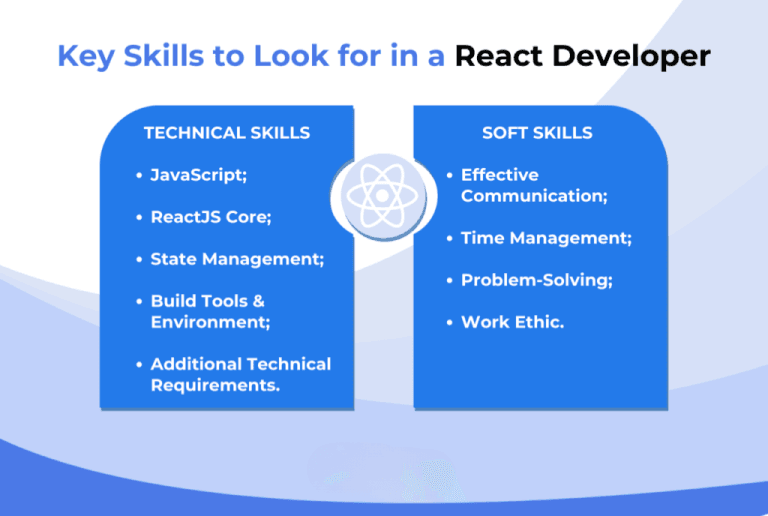
react-developer-skill-requirement

It’ll also attract the right candidates for the role. Ask yourself the following questions:

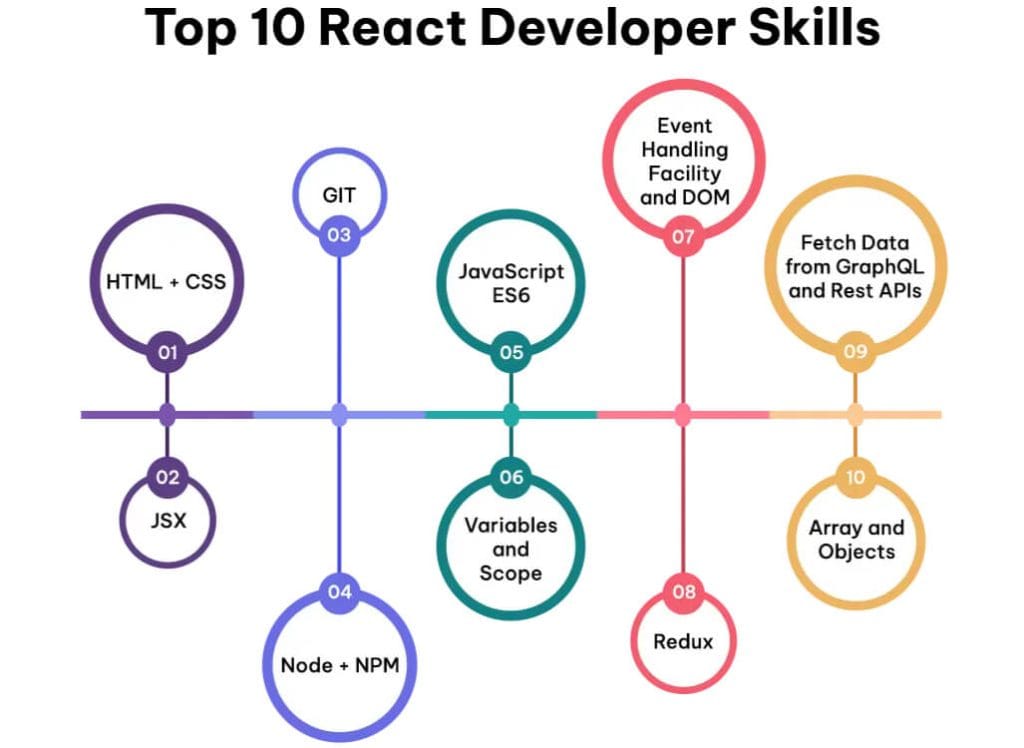
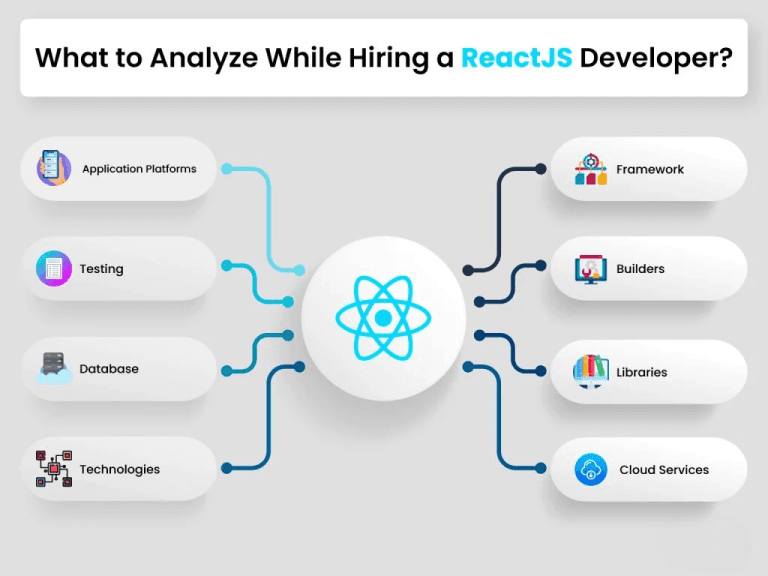
  • What’s your tech stack? If you’re using technologies like Redux, TypeScript, or GraphQL, look for developers experienced with those tools.
  • What’s the scope of the project? Are you looking for someone to build a standalone front-end app, or do you need a full-stack developer who can also handle the back-end?
  • What stage is your product at? If you’re in the early stages, you may need someone versatile who can wear multiple hats. If you’re scaling, you’ll need someone focused on performance and optimization.

Before hiring, define measurable success outcomes such as reducing page load time, improving UX scores, or achieving specific performance benchmarks. 

Because; what gets measured, gets improved.

Step 2: Craft a Compelling Job Description

Now that you know exactly what you’re looking for, it’s time to create a job description that not only highlights the required skills but also attracts the right talent. 

A well-crafted job description does more than just list skills—

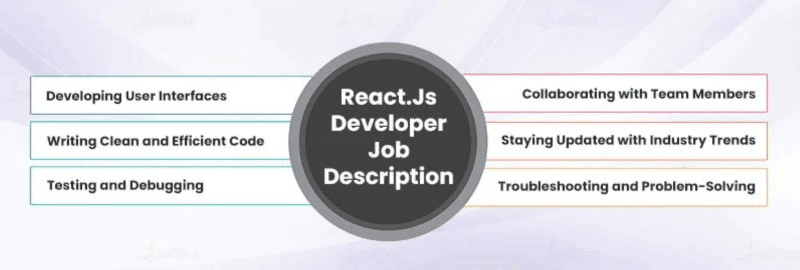
react-developer-job-description

It should make candidates excited about the opportunity to work with you.

Your job description should include:

  1. Role Overview: A brief introduction to your company and the impact this role will have on the product.
  2. Responsibilities: Clear tasks like building UI components, integrating APIs, optimizing performance, etc.
  3. Required Skills: Specific technologies like React, Redux, TypeScript, or GraphQL.
  4. Culture Fit: What kind of work environment do you have? Highlight whether it’s fast-paced, collaborative, or remote-first.
  5. Growth Opportunities: Developers are always looking to grow, so mention career progression, skill development, or leadership opportunities.

Make sure your job description speaks to both technical and personal growth. 

Talented developers want to feel like they’re building something meaningful and advancing in their careers. 

Also, mention real impact (“build features used by 10K+ daily users”) to attract top talent.

Step 3: Source Candidates the Smart Way

With your job description ready, it’s time to start sourcing candidates. Finding the right React developer isn’t just about posting a job and hoping the right person applies. 

It’s about proactively seeking out talent in the places where developers are most active.

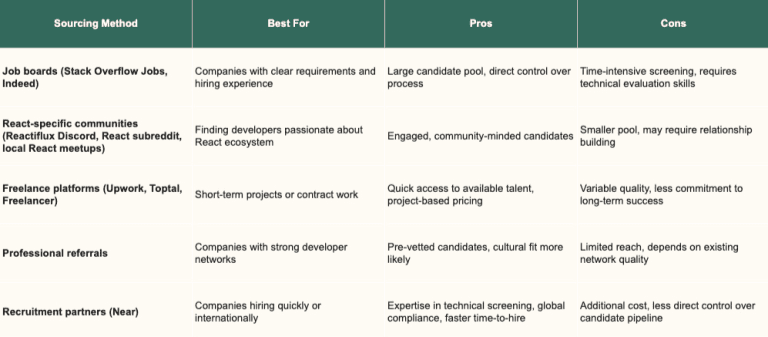
Here are some effective places to source React developers:

  • Developer Communities: Platforms like GitHub, Stack Overflow, and Reactiflux are hubs for React developers. Many contribute to open-source projects, so you can see their work firsthand.
  • Job Boards: LinkedIn, Indeed, and Glassdoor are great for posting open roles, but you can also actively search for profiles that match your requirements.
  • Referrals: Reach out to your network — whether it’s colleagues, previous employees, or fellow entrepreneurs. Often, great candidates come through personal recommendations
  • Recruitment Agencies: If you’re in for a more reliable approach, partnering with a recruitment agency specializing in tech can help you find candidates quickly.

If time is of the essence, IT staff augmentation can be a faster, lower-risk option.

react-developer-sourcing-methods

By partnering with firms like Inument, you can quickly access pre-vetted React developers who are ready to integrate with your team immediately, saving you months of sourcing and screening.

By sourcing from multiple channels, you increase your chances of finding a React developer who truly matches your needs. 

And if you’re looking for a reliable partner to streamline the process, Inument is here to help connect you with top-tier talent.

Step 4: Screen Applicants to Find the Best Fit

Once you start receiving applications, it’s time to dig deeper. 

A React developer’s resume can look impressive on paper, but the real test is whether they can apply their knowledge to solve real-world problems.

Remember, a bad hire doesn’t just cost you time; it can drain resources, delay product launches, and lower team morale. 

The longer you wait to address a mismatch, the more costly it becomes.

Here’s how to effectively screen your candidates:

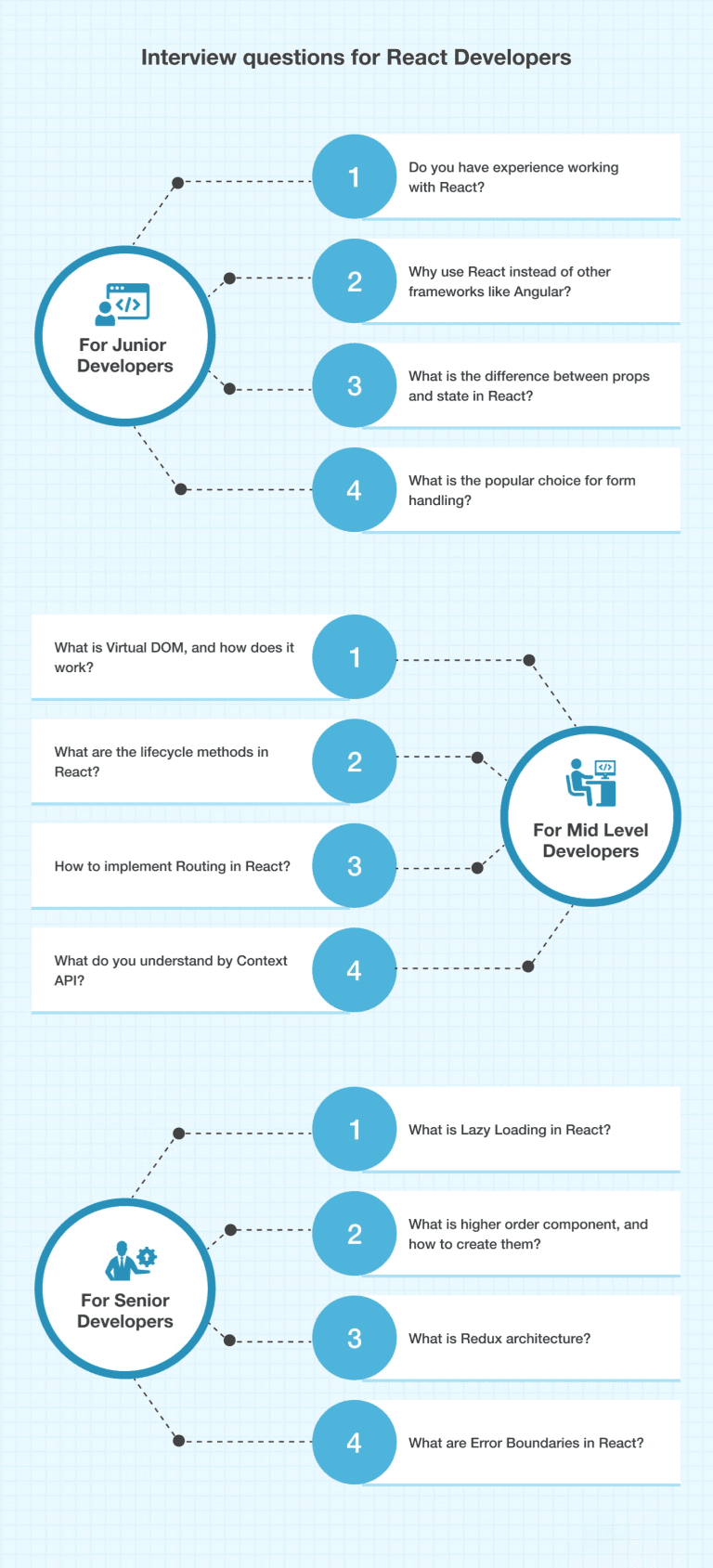
  • Technical Challenges: Provide coding challenges that test core React concepts like state management, lifecycle methods, and performance optimization. You could ask them to build a small app or component that demonstrates their proficiency with hooks, context, and API integration.
  • Code Review: Ask candidates to walk you through a piece of code they’ve written in the past. This gives you insight into their coding style, problem-solving process, and their ability to communicate complex ideas clearly.
  • Behavioral Questions: Use situational questions to assess their approach to problem-solving. For instance, ask, “How would you optimize an app that’s experiencing slow load times?” This helps you gauge their practical knowledge and creative thinking.
  • Soft Skills: Don’t forget to assess their communication skills. A great React developer not only writes clean, efficient code but also works well in a team, is receptive to feedback, and can explain technical concepts in simple terms.
  • Cultural Fit: Assess whether the candidate aligns with your company’s values and work style. Ask questions like, “How do you typically handle tight deadlines?” or “Tell us about a time you had to give or receive constructive feedback.”

A solid technical screening ensures you’re not just hiring a developer who can code, but one who can solve problems, work efficiently, and communicate effectively. 

react-developer-interview-questions

It also reduces the risk of bringing someone on who ultimately isn’t the right fit for your product or culture.

So, test for curiosity, not just competency.

Step 5: Final Onboarding

You’ve found the perfect React developer. Now it’s time to bring them onboard and set them up for success. 

A smooth onboarding process ensures that the developer integrates quickly, feels part of the team, and starts contributing immediately.

react-developer-onboarding-pro-tips

Here’s how to effectively onboard the new React developer you hired:

  1. Welcome Package and Introduction: Start with a warm welcome. Introduce them to the team, share your company’s mission and values, and outline your product vision. This helps them understand the bigger picture and how their work fits into the overall strategy.
  2. Tools and Access: Make sure your new developer has access to all the necessary tools from day one: version control systems (like Git), project management tools (Jira, Trello), and any other internal documentation or resources. This will allow them to hit the ground running without delays.
  3. Mentorship and Support: Assign a mentor or go-to team member who can provide guidance during the initial weeks. This helps the new hire feel supported and gives them someone to turn to with questions.
  4. Clear Expectations: Set clear goals for the first 30, 60, and 90 days. For example, in the first 30 days, the developer might focus on understanding the codebase and completing smaller tasks, while later milestones involve taking on more complex features and optimizations.
  5. Continuous Feedback: Keep the lines of communication open. Provide regular feedback, celebrate wins, and offer constructive criticism when necessary. Regular check-ins (especially in the first few months) will help ensure they stay on track and feel valued.

A strong onboarding process ensures your new React developer is set up for success, accelerates their ramp-up time, and helps them feel engaged and motivated to contribute.

The Reason Businesses Are Choosing React

When you think about modern web and mobile apps, chances are high that React is at the heart of them. From Meta and Netflix to Shopify and Airbnb, it’s what makes apps feel snappy, intuitive, and alive.

But why is it so popular? 

And why are businesses across industries betting on it to power their most critical applications?

Let’s explore: 

1. Flexibility to Move Fast

One of React’s biggest advantages is its flexibility, especially for startups. Building a new product often means iterating quickly based on user feedback. 

With React, developers can make changes and improvements rapidly without overhauling the entire codebase.

For example, Facebook, the creator of React, used it to revamp its entire interface, allowing engineers to quickly roll out new features without disrupting the user experience. 

For startups, this is especially a game-changer. You can test new features, collect data, and pivot as needed, all without a massive rewrite. 

If your business needs to innovate fast and frequently, React’s flexibility is your friend.

react-development-benefits

2. Scalability for Growth

As your startup grows, your application needs to scale with it. React shines here too, thanks to its component-based architecture. 

Each component in React is like a Lego piece: small, reusable, and easy to update without affecting other parts of the app.

This makes scaling apps much easier and more manageable, as you can simply plug in new components as needed.

On the flip side, enterprise applications that rely on heavy traffic or complex systems can benefit from React’s ability to scale without sacrificing performance. 

Instagram is a prime example: as a platform that handles millions of users, React’s virtual DOM and optimized rendering ensure it runs smoothly, no matter how many people are online.

React can support your growth at every stage; from MVP to millions of users, by making scaling as simple as adding new components.

3. Reusability and Code Efficiency

React encourages developers to build reusable components. Once you’ve built a component for your app, you can use it in multiple places without rewriting code. 

This reusability not only speeds up development but also leads to cleaner, more maintainable code in the long run.

For example, an e-commerce app could have a product card component that can be used across multiple pages, saving valuable time for developers. 

Instead of duplicating code, React allows you to simply call the same component when needed, which means faster updates, fewer bugs, and more efficient use of resources.

By reusing components, React makes development more efficient, saving time, cutting costs, and improving consistency across your app.

4. Strong Developer Community and Ecosystem

When you choose React, you’re not just choosing a tool; you’re tapping into a massive, active community. 

With thousands of open-source libraries, frameworks, and pre-built components, React developers have a wealth of resources to draw from.

Whether you’re building an app that needs a specific feature (like a chat widget or payment integration) or optimizing performance, React’s ecosystem has probably got you covered. 

And, if something doesn’t exist yet, the community will likely build it in no time.

React’s vast ecosystem and active community ensure you’ll never run into a roadblock. Solutions are always just around the corner.

5. Fast Performance with Virtual DOM

React’s Virtual DOM is one of its standout features. It acts as a lightweight copy of the real DOM, allowing React to quickly determine which parts of the UI need to be updated. 

By only updating the changed components instead of re-rendering the entire page, React drastically improves performance, especially in apps with complex UIs.

Take Netflix for example. React is behind its fast, fluid interface. Even with vast amounts of data being fetched and displayed, the app remains responsive and quick.

React’s Virtual DOM makes it ideal for high-performance applications that need to stay responsive even under heavy traffic.

6. Better Developer Experience

Finally, React makes life easier for developers. With features like JSX (JavaScript XML), developers can write UI code that looks very similar to HTML, making the development process more intuitive. 

The framework’s dev tools and debugging support also make identifying and fixing issues a breeze.

For businesses, this means you can expect faster development times and smoother collaboration between frontend and backend teams. 

React’s developer-friendly approach leads to fewer bottlenecks and quicker time-to-market.

top-10-react-develop-skills

A better developer experience means faster product iteration, better code quality, and more predictable delivery timelines.

To sum up: React isn’t just a fad; it’s a framework that gives businesses the power to innovate quickly, scale efficiently, and deliver exceptional user experiences. 

Choosing React means you’re not just investing in a technology. You’re investing in faster iterations, better scalability, and happier users

Common Hiring Pitfalls to Avoid

Hiring the right React developer is no small feat, and while the process can be streamlined, there are several common pitfalls that can derail even the most carefully planned search. 

Here’s what to watch out for:

  • Don’t overemphasize React-specific knowledge — focus on fundamental programming skills, problem-solving, and adaptability to new tools.
  • Soft skills matter just as much as technical skills — communication and collaboration are key to a developer’s success within your team.
  • Real-world coding challenges > algorithmic puzzles — test candidates with tasks that mirror the work they’ll actually be doing.
  • Cultural fit is crucial — a great developer who clashes with your team will disrupt more than they contribute.
  • Avoid rushing the hiring process — the best talent may take time to find, and haste leads to costly mismatches.
  • Don’t skip trial periods — a trial phase reveals how a developer adapts to your workflow and tackles real-world problems.
  • Assess for long-term impact — don’t just hire for today’s tasks; ensure the developer’s growth aligns with your product’s future needs.
  • Prioritize team dynamics over technical perfection — a perfect coder without the ability to work collaboratively will slow down progress.
  • Be wary of hiring out of desperation — React developers are in demand, but hiring out of urgency often leads to regrets.
  • Always test for scalability — ensure the developer can not only build but scale and optimize as your user base grows.

Avoiding these common hiring pitfalls ensures you attract not only the best technical talent but developers who will integrate smoothly into your team and help propel your product’s success.

How Much Does it Cost to Hire a React Developer?

The cost of hiring a React developer varies widely based on several factors, including their experience level, location, and the complexity of the project. 

Here’s a breakdown of what you can expect:

1. Experience Level

  • Junior (0-2 years): Typically, they are just starting out and may require more training and oversight. Expect to pay around $40,000 to $60,000/year for full-time roles.
  • Mid-Level (2-5 years): These developers have gained significant experience and can work independently on most tasks. Salaries typically range from $60,000 to $90,000/year.
  • Senior (5+ years): Experienced developers who can architect complex applications and lead teams. Their rates can vary from $90,000 to $130,000/year or more, depending on location and company size.

2. Location

  • North America & Western Europe: These regions tend to have higher salaries, with $100,000 to $150,000/year for senior developers.
  • Eastern Europe & Latin America: Costs here are often more competitive, with rates ranging from $40,000 to $80,000/year for mid-level developers.
  • Asia & Africa: Hiring in these regions can be much more affordable, with rates for developers typically ranging between $20,000 to $50,000/year, depending on the country.

3. Hiring Method

  • Full-Time Employment: In addition to the base salary, you’ll need to account for benefits, bonuses, and any other perks. This can increase the total cost by 25%-40% beyond the base salary.
  • Freelancers: Freelance React developers typically charge $30 to $100 per hour, depending on experience and expertise. Keep in mind that freelancers may have limited availability, and their rates could fluctuate.
  • Staff Augmentation: With staff augmentation, you get pre-vetted, skilled developers without the long recruitment process. Prices for augmentation services vary based on the country and the developer’s expertise but are often more cost-effective than traditional hiring, especially when you factor in the time saved.

4. Project Complexity

The more complex the project, the higher the cost. Projects requiring advanced React features like server-side rendering (SSR) with Next.js, Redux, or integration with complex APIs will require a more seasoned developer, thus increasing the rate.

While React developer costs vary, the key is to align your budget with your project’s needs and the expertise required. 

Whether you hire full-time, freelance, or through staff augmentation, make sure you’re getting value for the investment, and consider both short-term needs and long-term growth potential.

The Inument Way of Building Reliable Frontend Teams

Front-end hiring becomes easier when you have a partner who understands both engineering and execution. 

Inument gives you access to vetted frontend developers who know how to ship clean, stable, production ready interfaces. 

You get people who write readable code, communicate well with designers and backend teams, and move fast without breaking the foundation of your product.

Our engineers are trained on modern stacks like React, Vue, and Angular, along with strong fundamentals in JavaScript, performance tuning, accessibility, and responsive design. 

Each developer goes through a hands-on screening process focused on real projects, not theory. This means you avoid mismatches, slow starters, and hidden skill gaps.

Inument also helps you scale safely. Whether you are building an MVP or extending an enterprise level platform, you get engineers who fit your culture, follow your workflow, and start contributing quickly. 

No fire drills, no onboarding chaos, just steady delivery from people who know what they are doing.

If you want a frontend team that makes your product look good and work even better, Inument gives you a reliable way to build it.

Wrapping Up: Hire Smart, Build Better

Hiring a React developer doesn’t have to be a daunting task. With the right approach, you can build a frontend team that will not only meet but exceed your product’s needs.

At the end of the day, your product’s success hinges on the team you build, and that includes hiring the right React developer. 

Finding a talented developer who not only understands React but is also aligned with your company culture and product goals can make all the difference in creating a high-performance, user-friendly product.

At Inument, we specialize in helping tech entrepreneurs find and onboard top-tier React developers who can hit the ground running and help drive your product forward. 

We’re here to help streamline the process and ensure you’re making the right investment in talent.

Need pre-vetted React developers who can start fast and scale your product?

Talk to Inument today. We build teams that build your future.

About The Author

Zahir Rahat

Zahir Rahat

Want to Build Your Dream Tech Team? Hire Now!