Moving an application to the cloud does not automatically make it faster, more efficient, or easier to maintain.
A company might successfully move its business applications from physical servers to cloud infrastructure, only to discover that familiar problems remain. Software updates still take too long, applications struggle to communicate, and development teams continue spending valuable time maintaining outdated systems.
This happens because moving software to a new environment and improving how that software works are two different objectives.
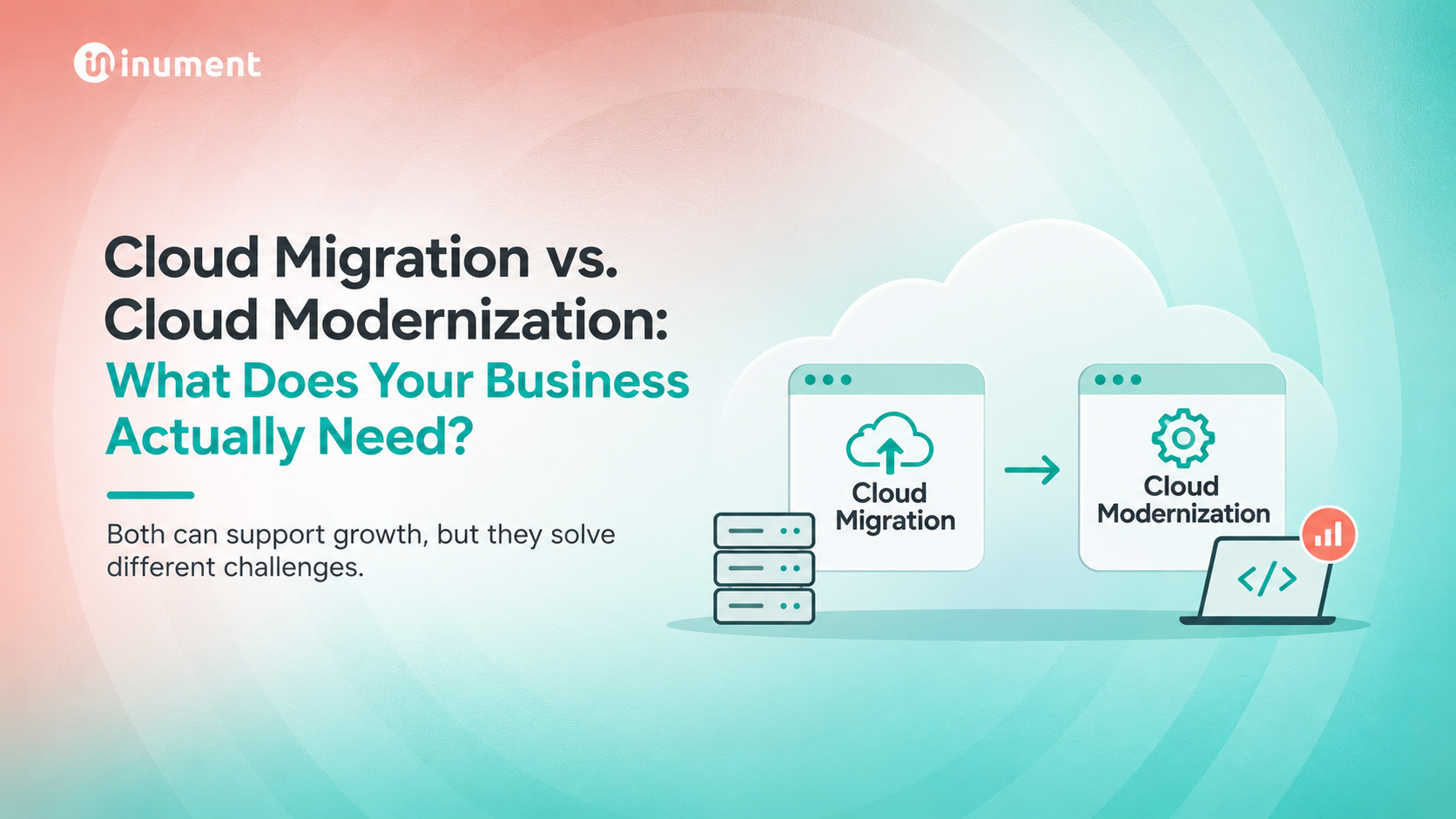
Cloud migration changes where applications run, while cloud modernization improves how applications are built, managed, and operated.
Both approaches can support business growth, but they address different challenges. Understanding their differences helps organizations invest in the right improvements instead of making technology changes that leave the underlying problems unresolved.
What Is Cloud Migration?
Cloud migration is the process of moving applications, databases, storage, and other IT resources from an existing infrastructure to a cloud environment.
Traditionally, many businesses have operated their software on physical servers located in their offices or data centers. These systems require hardware maintenance, infrastructure management, and capacity planning to keep applications running reliably.
Cloud migration allows organizations to move these workloads to platforms such as Amazon Web Services (AWS), Microsoft Azure, or Google Cloud.
Consider a company that manages customer records, sales information, and inventory through software hosted on its own servers. As the business grows, maintaining the infrastructure becomes increasingly demanding. The company decided to move its existing application and database to the cloud.
After migration, employees continue using the same software, but the application now operates on cloud infrastructure rather than the company’s physical servers.
One common method is known as lift and shift, or rehosting. This approach moves an application to a new hosting environment with minimal changes to its underlying code or architecture.
Cloud migration can give businesses greater infrastructure flexibility, reduce dependence on physical hardware, and provide access to managed infrastructure services.
However, the application itself may remain largely unchanged.
If the software previously relied on inefficient database queries, complicated integrations, or manual deployment processes, those limitations may continue after migration.
Cloud migration can improve the environment supporting an application, but it does not necessarily improve the application itself.
What Is Cloud Modernization?
Cloud modernization focuses on improving existing applications and technology systems so they can better support current business requirements and future growth.
Instead of concentrating only on where an application runs, modernization examines how the application is designed, how its components communicate, and how efficiently teams can maintain and improve it.
For example, a business might already host its software in the cloud but still rely on an outdated application architecture. Adding new features takes weeks, certain processes slow down during busy periods, and connecting the application with other business systems requires significant engineering effort.
Moving that application to another cloud server would not necessarily solve these problems.
The business may need to improve the application code, optimize its database, introduce better API integrations, or automate testing and deployment.
These improvements are part of cloud modernization.
Modernization can involve several levels of change. Replatforming moves application components to more suitable cloud services with relatively limited code changes. Refactoring improves existing code to make it easier to maintain or more efficient. Rearchitecting involves more substantial changes to how different parts of an application are structured and connected.
The right approach depends on the problems the business needs to solve.
Importantly, cloud modernization does not always require rebuilding software from scratch.
An organization may achieve meaningful improvements by modernizing only the components that create performance problems, increase maintenance costs, or prevent future development.
The objective is to make existing technology more reliable, adaptable, and manageable without introducing unnecessary complexity.
Cloud Migration vs. Cloud Modernization: Understanding the Real Difference
Although cloud migration and cloud modernization are closely connected, their priorities are different.
Cloud migration primarily focuses on infrastructure. It helps businesses move existing workloads from one computing environment to another. The application may continue operating in much the same way, but the organization gains access to different infrastructure capabilities and management options.
Cloud modernization focuses on improving the system itself. It addresses limitations in application architecture, software development, integration, performance, and operational processes.
This difference also affects how businesses plan technology investments.
A straightforward migration may require relatively few changes to application code, particularly when the existing system is compatible with the target cloud environment. Modernization can require more detailed engineering work because it involves understanding how the software operates and identifying which changes will create measurable improvements.
The outcomes can also differ.
Migration may reduce physical infrastructure responsibilities and provide more flexible computing capacity. Modernization can help improve application maintainability, streamline software delivery, and make systems better prepared for changing business requirements.
However, neither approach guarantees lower costs or better performance on its own.
An application that uses computing resources inefficiently may remain expensive after migration. Similarly, an unnecessarily complicated modernization project can introduce additional costs, technical risks, and maintenance requirements.
The most effective strategy is determined by the business problem rather than the technology being adopted.
A Practical Example: Migrating an E-Commerce Platform vs. Modernizing It
Imagine an e-commerce company that operates an online store connected to its inventory, payment, and order management systems.
The platform has supported daily operations for several years. However, as customer demand grows, the company starts experiencing slow order processing during busy periods.
Its engineering team also struggles to release new features because different parts of the application are tightly connected.
The company decides to improve its technology infrastructure.
What Happens If the Company Chooses Cloud Migration?
The company moves its application and database from physical servers to cloud-hosted infrastructure.
This reduces its dependence on on-premises hardware and provides access to flexible computing resources.
The migration is completed, and the online store continues functioning.
However, the order management system still relies on the same internal processes. Inventory updates and payment operations remain tightly connected, and software releases still require substantial manual coordination.
Although the infrastructure has changed, the limitations in the application’s design remain.
Increasing server capacity might help with certain performance problems, but it does not necessarily address inefficient processing or complicated software dependencies.
What Happens If the Company Chooses Cloud Modernization?
Instead of focusing only on infrastructure, the engineering team investigates what causes delays in the order management process.
The team discovers that some database operations are inefficient and that background inventory updates compete with customer-facing requests for computing resources.
Developers optimize the affected database queries, improve communication between application components, and move suitable background tasks into asynchronous processing.
They also introduce automated testing and deployment processes to reduce the manual effort involved in software releases.
These changes can help the business process orders more efficiently and make future application updates easier to manage.
The company does not need to replace its entire e-commerce platform. It focuses on improving the areas that directly affect performance and business operations.
The key difference is that migration changes the application’s hosting environment, while modernization addresses the design and processes that influence how effectively the application works.
Why Moving to the Cloud Is Not Always Enough
Businesses often adopt cloud infrastructure with expectations of improved performance, reduced costs, and greater flexibility.
These benefits are possible, but moving applications to the cloud does not automatically deliver all of them.
One important reason is that existing software limitations can remain after migration.
Applications developed many years ago may have tightly connected components, outdated dependencies, or inefficient data-processing methods. These characteristics are often described as technical debt when they make software increasingly difficult or costly to maintain.
Moving such applications to the cloud does not remove this technical debt. The same underlying issues can continue affecting reliability and development efficiency.
Cost is another consideration.
Cloud platforms allow organizations to provision computing resources without purchasing physical servers. However, businesses still pay for the resources and services they consume.
Applications that are not designed or configured efficiently may use more computing capacity than necessary. Unused resources, oversized servers, and inefficient storage or data-transfer patterns can increase cloud expenses.
Modernization and ongoing cloud cost optimization can help businesses use these resources more effectively, but savings depend on actual workload requirements.
Software delivery creates a similar challenge.
If developers previously needed several days to test and release an application update, moving the application to cloud infrastructure will not automatically shorten that process.
Improving deployment pipelines, automated testing, monitoring, and application dependencies may be necessary to make software releases faster and more reliable.
These examples show why cloud adoption should consider both infrastructure requirements and application quality.
When Is Cloud Migration the Right Choice?
Cloud migration is often a suitable option when a business has applications that function reliably but wants to improve the infrastructure supporting them.
For example, an organization may be operating aging physical servers that require expensive maintenance. Replacing the hardware could involve significant upfront investment, while moving suitable applications to cloud infrastructure may provide a more flexible alternative.
Migration can also make sense when a company needs to consolidate infrastructure, leave an existing data center, or improve its access to cloud-based backup and disaster recovery capabilities.
In these situations, the existing software may already meet business needs.
The organization does not necessarily need to redesign the application. Its immediate objective is to move the workload to a more suitable environment while maintaining functionality and minimizing disruption.
However, migration planning should still account for application compatibility, database dependencies, network requirements, security, operating costs, and business continuity.
A successful migration requires more than transferring files or launching new servers. The application must continue working correctly within its new environment.
When Does Cloud Modernization Become Necessary?
Cloud modernization becomes more valuable when software limitations begin affecting a company’s operations, development speed, or ability to grow.
A business may already be using cloud services but find that its applications are increasingly difficult to update.
Adding a new feature might require changes across multiple connected components. Integrating a customer relationship management system with an existing platform might demand extensive custom development. Performance problems may continue even after increasing computing resources.
These situations suggest that infrastructure alone is not the main problem.
The organization needs to examine its application architecture, code quality, integrations, and operational processes.
Modernization can help address these challenges through targeted engineering improvements.
For businesses introducing advanced analytics, workflow automation, or AI-powered capabilities, the condition of existing systems becomes particularly important.
For example, an AI-powered business process may need dependable access to information from multiple applications. If that information is scattered across disconnected systems or difficult to access consistently, deploying a new AI tool will not resolve the underlying integration problem.
Modernizing data flows and application interfaces may be necessary before the new capability can operate reliably.
This is why cloud modernization is not simply about adopting newer technology. It is about preparing existing systems to support the capabilities a business actually needs.
Should Businesses Migrate First or Modernize First?
There is no single sequence that works for every organization.
Some businesses benefit from migrating stable applications first and modernizing them gradually afterward. Others need to make application improvements before or during migration because their existing software cannot operate effectively in the target environment.
The decision should begin with a clear understanding of business objectives and technical constraints.
If the immediate priority is leaving an aging data center, migrating suitable applications with minimal changes may be practical.
However, if an application already experiences serious performance, reliability, or compatibility problems, moving it without addressing those issues may create additional work later.
In that case, modernization before or during migration may be more effective.
Organizations can also adopt a phased approach.
For instance, a company might move a stable internal reporting application directly to the cloud while modernizing its customer-facing platform because that platform requires greater scalability and more frequent updates.
This allows the business to apply different strategies to different workloads rather than treating its entire software environment as one project.
The important principle is to make changes according to business value, technical necessity, and acceptable risk.
A complete application rebuild should not be the default choice when smaller improvements can deliver the required outcome.
How to Build an Effective Cloud Strategy
A successful cloud initiative begins by understanding the systems a business already has.
Before deciding what to migrate or modernize, organizations should assess their applications, infrastructure, databases, and integrations.
This assessment should identify which systems are performing reliably, which require excessive maintenance, and which are limiting business operations.
The next step is to define the improvements the organization expects.
For one company, success may mean reducing the cost of maintaining physical infrastructure. For another, it may mean supporting more transactions, improving application availability, or reducing the time required to release new features.
These outcomes help determine the appropriate technical approach.
A stable application may only need migration. Another application may benefit from moving to managed cloud services. A business-critical system with significant architectural limitations may require more substantial modernization.
Security and reliability should remain central throughout the process.
Moving applications or changing their architecture can affect access controls, data protection, system dependencies, and availability. Businesses need appropriate testing, monitoring, backup procedures, and recovery plans to manage these risks.
After implementation, organizations should measure whether the changes have delivered the intended results.
For example, a company seeking better performance can monitor application response times and error rates. A team trying to improve software delivery can measure deployment frequency and recovery time after failures.
Businesses focused on cost can evaluate infrastructure spending in relation to actual usage or business transactions.
These measurements help organizations understand whether their cloud investments are creating practical value rather than simply introducing new technology.
Final Thoughts: The Goal Is Better Business Systems, Not Just Cloud Adoption
Cloud migration and cloud modernization serve different purposes, but both can play an important role in building a more effective technology environment.
Migration provides a way to move applications and infrastructure to the cloud. Modernization improves how applications are designed, maintained, and operated.
For some businesses, migration is enough to achieve their immediate objectives. Others need modernization to address existing software limitations and prepare for future requirements.
Many organizations benefit from a combination of the two.
The right decision depends on understanding what is already working, identifying what needs improvement, and choosing the level of technical change that delivers meaningful business value.
Moving to the cloud is a technology decision. Making your systems work better for the business is the larger objective.
For organizations planning their next stage of digital transformation, the most useful question is not simply whether to migrate or modernize.
It is whether their current technology can reliably support the business they are building.
Build Cloud Systems That Support Your Next Stage of Growth
At Inument, our focus on Custom Software Engineering, Data & Cloud Engineering, and AI Transformation helps businesses approach technology improvements with their operational needs in mind.
Whether the challenge involves legacy applications, disconnected systems, or cloud-ready software architecture, the right starting point is understanding what needs to change and why.
Let’s Build What’s Next.