 Let’s Talk
 Inument


You’ve got a brilliant app idea. You want it live on both iOS and Android, and fast.
But here’s the catch: you don’t want two teams, double the cost, or months of chaos before your MVP even breathes.
That’s where Flutter walks in like the cool kid who can play both sides of the playground.
Google’s open-source UI toolkit has redefined cross-platform app development, letting founders build beautiful, high-performing apps from a single codebase. It’s fast, efficient, and scalable.
This is why a whooping 95% of global developers nowadays use Flutter to build high-performance, cross-platfom applications.
But there’s a twist: your success doesn’t just depend on Flutter itself. It depends on the Flutter developers you hire.
The real challenge is finding developers who can build for both platforms without doubling the time and cost.
And that’s where most founders stumble. They assume that if someone “knows Dart,” they can magically build a production-grade app.
But in reality, the gap between “can code” and “can build a reliable, scalable app that users love” is massive.
Hiring the right Flutter developer determines whether your app succeeds or becomes another “almost made it” project. Relying on the wrong Flutter developer can derail timelines, inflate costs, and turn your sleek product vision into a bug-ridden headache.
So, how do you find the right one: the developer who understands Flutter app performance, architecture, and product goals as deeply as you do?
That’s what this guide is all about.
This Flutter developer hiring guide will break down how to hire skilled Flutter app development partners, avoid common hiring mistakes, and take your Flutter app towards cross-platform success; all without breaking your mind (and budget).
Let’s get your hiring strategy as solid as your app idea.
The Hiring Chaos Most Founders Fall Into
Let’s be honest: hiring a Flutter developer can feel like walking through a tech bazaar: everyone’s shouting “I can build your dream app!” while waving a generic portfolio that looks suspiciously similar to the last five you saw.
You post your job, applications pour in, and every single one claims to be a “Flutter expert.”
Every portfolio looks polished, and every quote sounds like a steal… until you sign the deal.
But once the project begins, deadlines start to slip, bugs pile up, and communication dries up faster than your patience.
Sound familiar? You’re not alone.
Here’s why: most hiring mistakes happen before a single line of code is written.
Let’s look at some of the common Flutter hiring mistakes that trap even the smartest founders:
1. Hiring Based on Cost, Not Capability
Let’s start with the classic trap: hiring cheap to “save budget.”
Sure, it feels smart in the short run. But when your $15/hour freelancer builds a codebase that can’t scale or crashes on iOS, the savings disappear fast.
Here’s what you get with a bad developer hiring: rewrites, delays, and missed launch dates. The $15/hour “bargain” quickly becomes a $30,000 rewrite six months later.
This is how the cheapest option often turns into the most expensive mistakes, blocking your road to cross-platform success.
2. Confusing “Knows Flutter” with “Builds for Scale”
There’s a big difference between someone who knows Flutter syntax and someone who architects Flutter apps for performance.
You don’t just need someone who writes Flutter code. You need someone who writes production-grade Flutter code.
Anyone can follow a YouTube tutorial, only a few can design modular architecture, handle API integrations cleanly, and optimize app performance issues for both iOS and Android.
A true Flutter developer understands Flutter scalability, state management, widget tree optimization, and efficient API handling.
The wrong one?
They’ll ship you an app that looks fine but lags, leaks memory, and burns your users’ batteries. You’ll end up with an expensive cross-platform development failure.
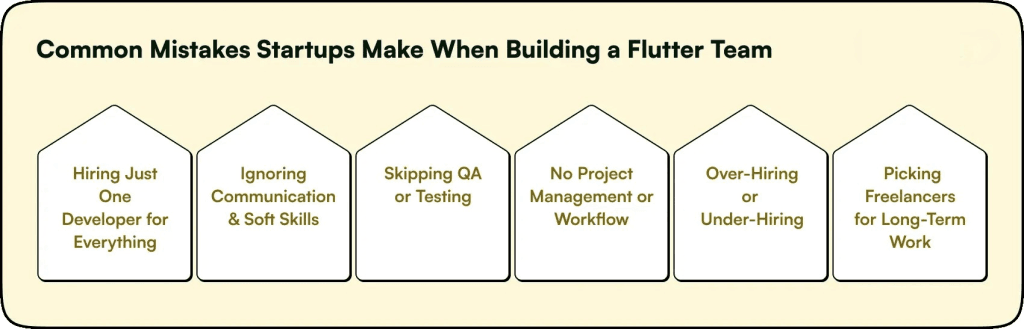
3. Ignoring Collaboration Skills
You’d be surprised how many projects fall apart not because of bad code, but because of bad communication. Developers who ghost you mid-project or vanish after a bug report are not that rare.
When updates stop, documentation disappears, and “quick fixes” break production, your development roadmap turns into guesswork.
The best Flutter developers communicate clearly, document their work, and anticipate problems before they explode into chaos.
Remember, Flutter may unify your codebase; but if your team isn’t unified, no framework can save the project.
4. Skipping Technical Vetting
In the rush to build a jaw-breaking MVP, many founders skip technical assessments because they “need to move fast.”
They end up putting their faith solely on eye candy portfolios, fabricated past projects, and smooth talks,
Three sprints later, they realize the developer has never handled API pagination, CI/CD pipelines, or production deployments.
The very thing that was supposed to speed up their process ends up slowing them down.
Ironic, isn’t it?
If you want to avoid being on that side of the fence, test your candidates rigorously. The safest and most efficient way to tackle mobile app development challenges is to be prepared from the very beginning.
A simple 3-hour technical test could save you 3 months of headaches.
How to Find Reliable Flutter Developers (Step-by-Step)
By now, you know the pain of a wrong hire: missed deadlines, bloated costs, and apps that perform worse than your first website from 2010.
But here’s the good news: finding reliable Flutter developers isn’t luck. It’s process.
When you follow the right steps, you can separate the real pros from the portfolio polishers, and build cross-platform mobile apps that actually perform.
Here’s your smart founder’s Flutter developer checklist for hiring:
Step 1: Define Your Project Scope Clearly
Before you even post a job, get clarity on what you’re building. Ask yourself:
- What’s the primary goal of my app?
- Who’s the target user?
- What features are must-haves vs nice-to-haves?
- What’s the expected launch timeline?
- What’s my post-launch maintenance plan?
Document these answers. Then turn them into a project brief. A clear scope filters out half the confusion before hiring even starts.
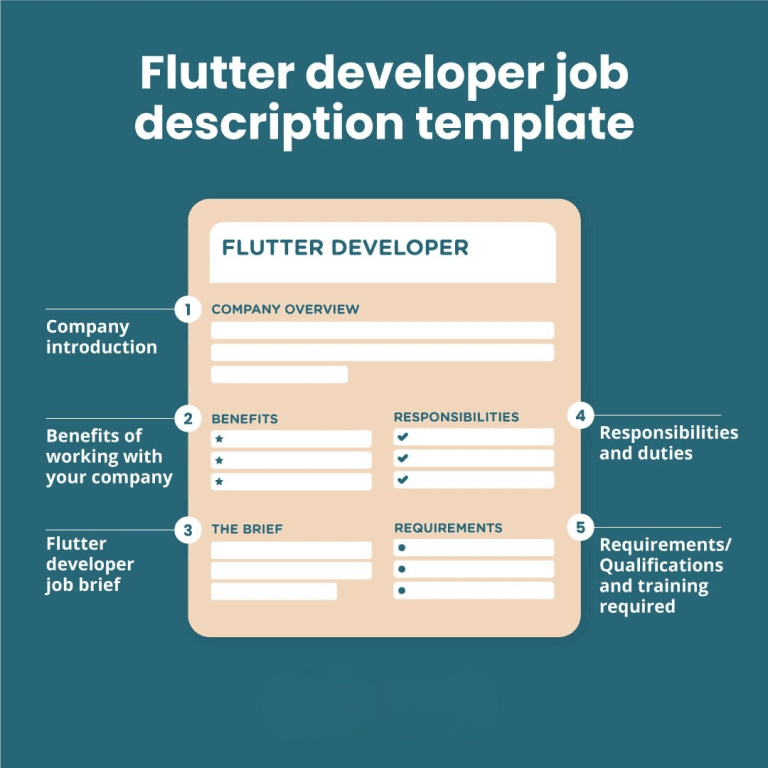
Developers who understand your project vision from day one will plan better, code smarter, and help you achieve Flutter app success.
Use tools like Notion or Miro to visually map your features, integrations, and dependencies before hiring.
Pro tip: Always document your MVP roadmap, milestones, and key deliverables before the first interview. The more clarity you provide, the more quality you’ll attract.
Step 2: Assess Technical Depth, Not Just Framework Familiarity
Flutter experience isn’t the same as Flutter expertise. Plenty of developers can “build an app,” but far fewer understand how to architect one that scales.
You need developers who understand Dart, state management (Bloc, Provider, Riverpod), API integration, and performance optimization.
Ask candidates how they’ve handled animations, app size reduction, or memory leaks in past projects.
Their answers will reveal whether they’ve actually built production-grade apps, or just followed tutorials. Here’s what to look for while evaluating Flutter talent:
They —
- Can explain the difference between Bloc, Riverpod, and Provider (and when to use each).
- Has the capability to optimize rendering and widget trees to ensure 60fps smoothness.
- Writes clean, testable code following architecture principles (MVVM, layered structure).
- Can handle Firebase integrations (Auth, Firestore, Push Notifications).
- Is familiar with technologies like REST APIs, GraphQL and Dart.
- Is skilled in state management (Bloc, Provider, Riverpod).
- Has automated testing experience.
Remember, the best developers will walk you through their thinking, not just their syntax.
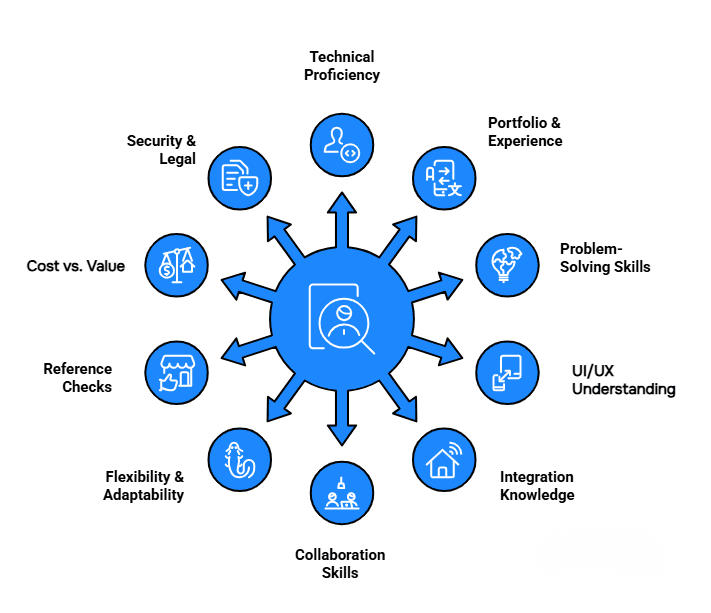
To get a clearer picture of their thought process, ask scenario-based questions, like:
- How would you handle real-time updates in a chat app?
- What would you do if the app becomes sluggish on older Android devices?
- How do you manage dependency injection in Flutter?
Step 3: Review Real Projects, Not Just Resumes
Portfolios are nice, but code speaks louder. Ask for access to a public GitHub repo, or better, a small live demo of a project they’ve worked on.
Additionally, you can reach out to past clients or project partners. Nothing beats firsthand feedback.
Here’s what to review:
- UI consistency: Do widgets adapt cleanly across screen sizes?
- Code structure: Are files organized or chaotic?
- Performance: Does the app load quickly and run smoothly
- Navigation flow: Can the users navigate your app easily?
You can also ask them to explain a past challenge; like optimizing build size or managing asynchronous data and how they solved it.
You’ll know right away if they understand how to craft a seamless cross-platform experience or if they’re still wrestling with layout widgets.
Pro tip: Use tools like Flutter Inspector to analyze performance metrics if they provide a demo build.
Step 4: Test for Problem-Solving and Collaboration
Even the best coders fail without strong problem-solving and teamwork skills. That’s why a paid test project is worth every dollar.
You’ll learn more from a 2-day test than 10 interviews.
Give them a mini version of a real problem, something like:
“Build a product listing page with a filter option and offline caching.”
Then evaluate:
- How they approach bugs.
- How they plan the architecture.
- How they communicate their process.
- How clean their commits and comments are.
- How they handle blockers or unclear requirements.
If you’re hiring a remote Flutter developer, use this phase to assess communication cadence, timezone overlap, and ownership. These factors make or break distributed teams.
Step 5: Verify Communication, Culture, and Continuity
A developer can be a technical genius and still tank your project if they can’t communicate clearly or align with your team culture. You want proactive collaborators, not message ghosts.
Your developer should understand your priorities, give clear updates, and align with your workflow.
Look for someone who:
- Proactively shares progress and roadblocks.
- Documents decisions (code comments, tickets, changelogs).
- Asks clarifying questions before rushing to code.
- Understands your product goals, not just technical specs.
If you’re working with remote or offshore Flutter developers, check timezone overlap and responsiveness. Also, during onboarding, set clear communication norms: weekly sprint updates, async check-ins, and shared task boards.
Lastly, Maintain a knowledge base or onboarding doc for quick ramp-ups if the team expands.
Pro tip: Set a fixed weekly sync + async updates through tools like Slack, ClickUp, or Jira. This structure eliminates 90% of misalignment issues.
The Domino Effect of a Wrong Hire
Here’s what happens when those hiring mistakes pile up:
- Delays multiply. That “6-week MVP” turns into a 4-month ordeal.
- Costs spiral. You pay twice: once for the build, again for the fix.
- Product quality suffers. Lagging UI, random crashes, and poor user reviews kill momentum.
- Team morale dips. Developers blame design. Designers blame code. Founders lose faith.
And perhaps worst of all; your vision, the one that excited investors and early users, gets lost under layers of broken code and rework tickets.
You end up with consistent bad app performances and a Frankenstein codebase that no one wants to maintain.
If you’ve ever waited 3 months for a simple update, you know what I mean.
But here’s the truth: it doesn’t have to be that way. The key is finding the balance between cost efficiency and expertise.
In the next section, we’ll walk through the hidden challenges of hiring the ideal flutter developer, so your next project doesn’t just launch, it lasts.
Cost Implications: What You’re Really Paying For When Hiring Flutter Developers
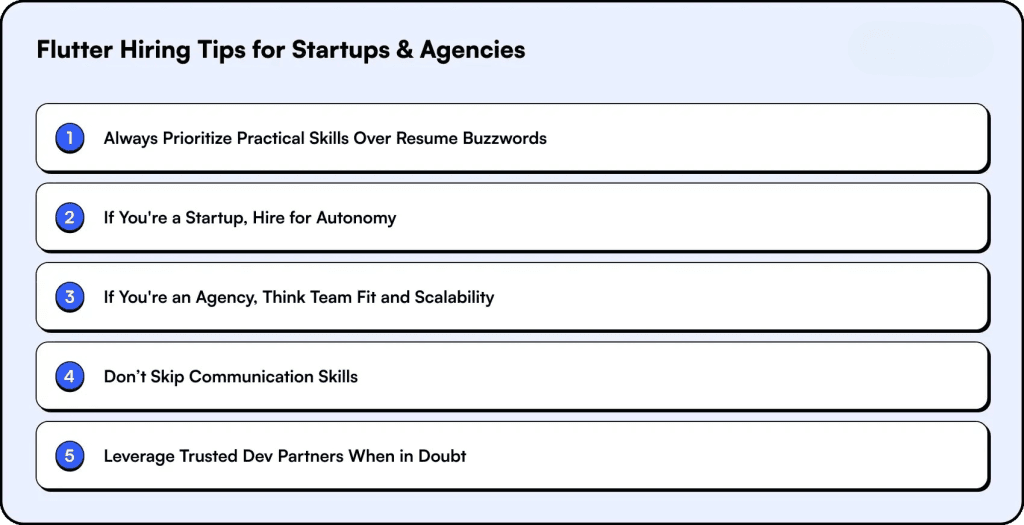
Let’s talk about the part every founder secretly worries about: cost.
Everyone loves Flutter for startup and enterprise solutions because it’s “cost-effective.”
But here’s the truth: how you hire matters just as much as what you’re building.
Flutter can save you thousands, or waste twice as much; depending on how smartly you manage your development investment.
The Real Cost Equation
When hiring top Flutter engineers, you’re not just paying for code. You’re paying for speed, scalability, and stability.
The right developer saves you money not by charging less, but by delivering more with fewer project delays and costly errors.
Let’s break it down:
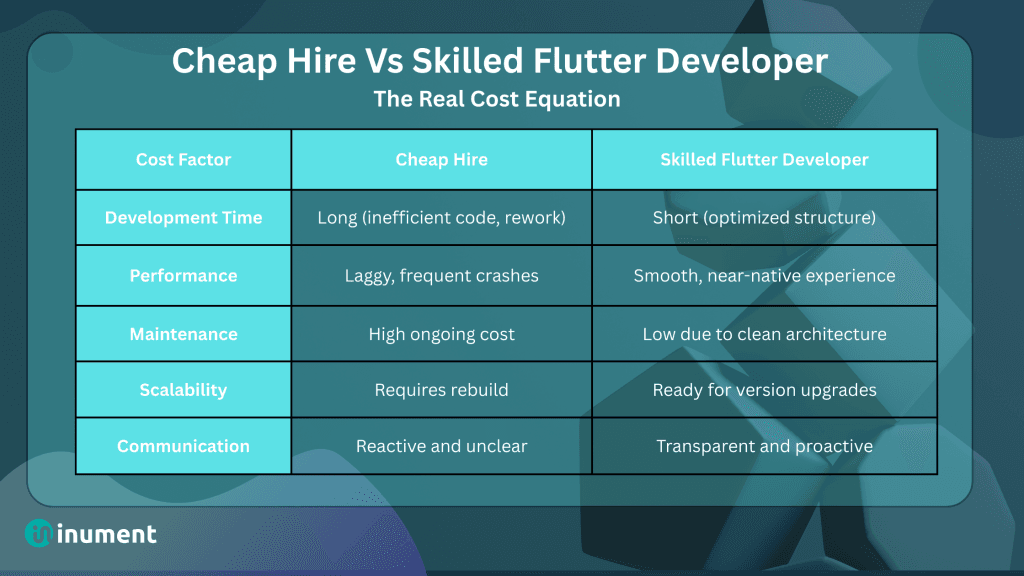
You can save upfront with a budget hire, but you’ll often pay 2X later in fixes, rewrites, and lost users.
Cost Ranges and What to Expect
Rates vary by region and experience, but here’s a general picture:
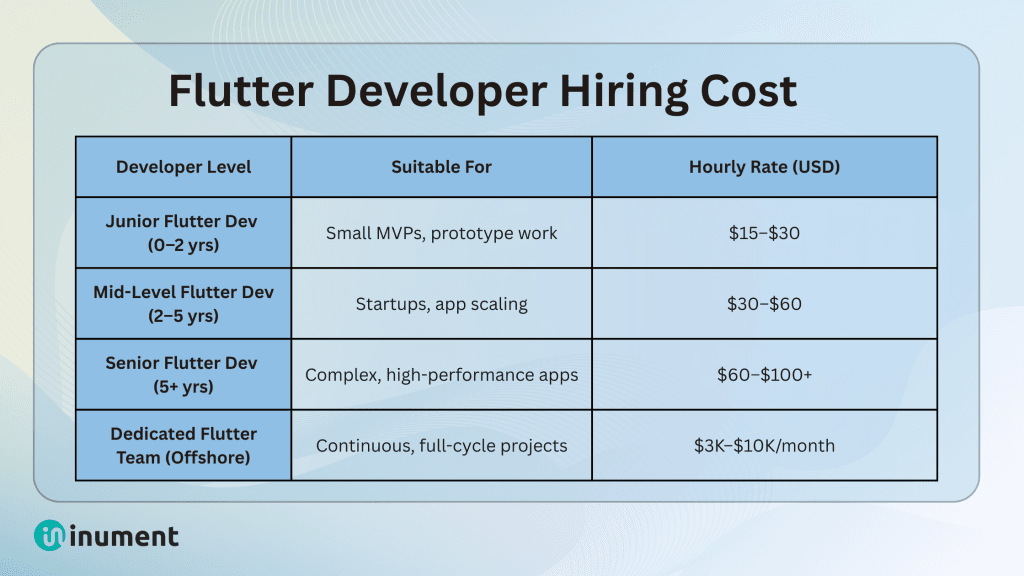
The math is simple: The right Flutter developer isn’t an expense. They’re an asset that compounds value over time.
In-House vs. Offshore vs. Augmented Teams
Let’s talk development models as each model has their own set of trade-offs. Understanding them helps you control cost without sacrificing quality.
Here’s what you need to keep in mind:
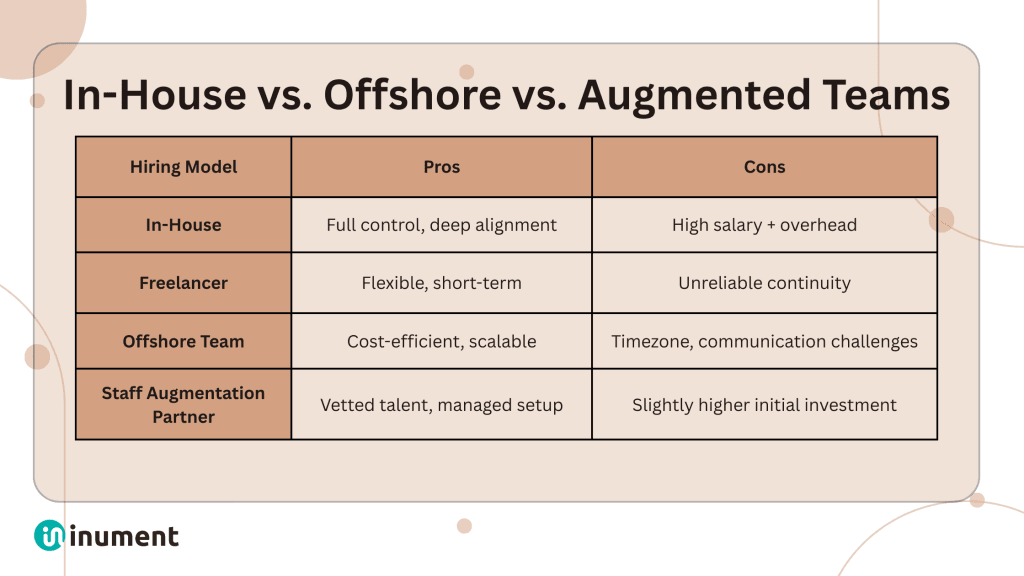
If you’re running a startup or scaling a SaaS, staff augmentation often hits the sweet spot; giving you access to vetted developers without the overhead of full-time hiring.
The Hidden Costs You Don’t See on Paper
- Rework: Poorly structured code means you’ll spend months fixing what should’ve been right the first time.
- Delays: Every missed sprint costs momentum (and sometimes investor confidence).
- Maintenance: A clean codebase is cheaper to update when Flutter releases new versions.
- User Churn: Performance issues = bad reviews = lost revenue.
- Geography: A developer from Asia will cost a fraction of the developers in the USA or Europe.
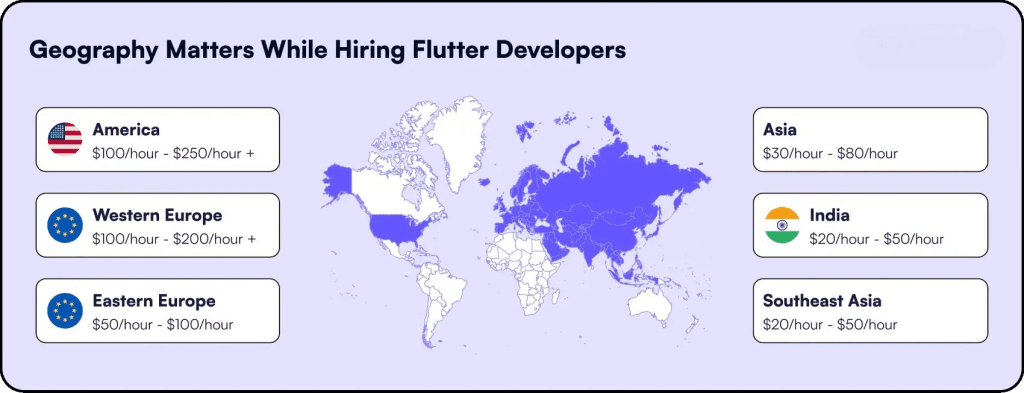
Don’t forget, the best developers aren’t always the most expensive. They’re the ones who understand your business context and code accordingly.
Inument: Your Shortcut to Reliable Flutter Talent
At Inument, we make hiring Flutter developers simple, fast, and reliable.
Instead of sifting through untested resumes or gambling on freelancers, you get pre-vetted engineers who’ve already tackled cross-platform app challenges across SaaS, FinTech, and eCommerce.
All of our Flutter experts go through a rigorous screening process that tests their technical depth in top Flutter skills, architecture design, and performance optimization; so you start building from day one, not training from scratch.
Our engagement model is fully transparent. No hidden costs, no messy handovers.
You can scale your Flutter team up or down anytime, with clear reporting and full visibility on delivery progress.
With Inument, you’re not just hiring coders; you’re adding an extension of your core team that understands both technology and business outcomes.
We help founders launch faster, scale smarter, and build cross-platform apps that perform like native ones, without the hiring headaches.
Wrapping Up: Build It Right the First Time
Finding the right Flutter developer isn’t just about filling a role. It’s about building your app’s foundation; the part that decides whether your product scales or stalls.
Flutter gives you the speed, flexibility, and performance to win across platforms, but only if it’s built by people who understand how to turn clean code into business impact.
And that’s where your hiring decision becomes your greatest leverage.
So, skip the endless trial hires, the rushed contracts, and the painful rewrites. Choose developers who think like founders, build like architects, and communicate like partners.
Remember, you’re not just hiring a coder; you’re hiring a co-builder for your product’s future.
Need Help Hiring Top Flutter Talents?
If you’re serious about launching a cross-platform app that feels native, performs flawlessly, and scales with your business, Inument is ready to help.
Talk to us today and get your Flutter team up and running, without the hiring headaches.
About The Author

admin
Related Insights

The Secret Behind Why Startups and Enterprises Prefer React JS
30 December 2025

AI/ML Engineer Hiring Guide: How to Find Engineers Who Actually Understand Your Data
23 December 2025

Smart Strategies for Hiring Top-Tier Tech Staff in Singapore
17 December 2025

Nearshore vs Offshore Outsourcing: How to Make the Best Choice for Your Business
10 December 2025

React Developer Hiring Guide: How to Build the Perfect Frontend Team
03 December 2025
