
 Let’s Talk
 Inument


Everyone’s talking about AI.
But here’s the catch: while startups are rushing to “add AI,” few actually know who they need to make it work.
You don’t just need someone who can train a model. You need someone who understands your data, your product, and your goals.
Because a model that predicts without context is like a GPS that doesn’t know where you’re starting from.
Hiring the right AI/ML engineer isn’t just about technical brilliance. It’s about finding a partner who can translate your messy data into meaningful business outcomes. Someone who knows when to experiment, when to optimize, and when to ship.
And that’s where most teams go wrong: they hire fast, not smart.
The result? Over-engineered models, ballooning costs, and “AI projects” that never see daylight.
This guide walks you through how to avoid that, step by step. You’ll learn how to define your needs, craft job descriptions that attract real talent, and screen candidates who can actually deliver value.
Because in today’s AI race, you don’t need more engineers.
You need the right one, and here’s how you do it —
Step 1: Define Your AI/ML Goals Before You Hire
Before you post that job on LinkedIn and pray for the next “AI wizard” to appear, pause for a moment.
Ask yourself one question:
“Why do we actually need an AI/ML engineer?”
If your answer sounds anything like “because everyone’s doing it,” it’s time to dig deeper.
AI works best when tied to a clear business outcome. Do you want to:
- Automate manual processes?
- Predict customer behavior?
- Optimize supply chain decisions?
- Build personalization or recommendation engines?
Each of these goals requires a different type of engineer and a different set of skills.
For instance:
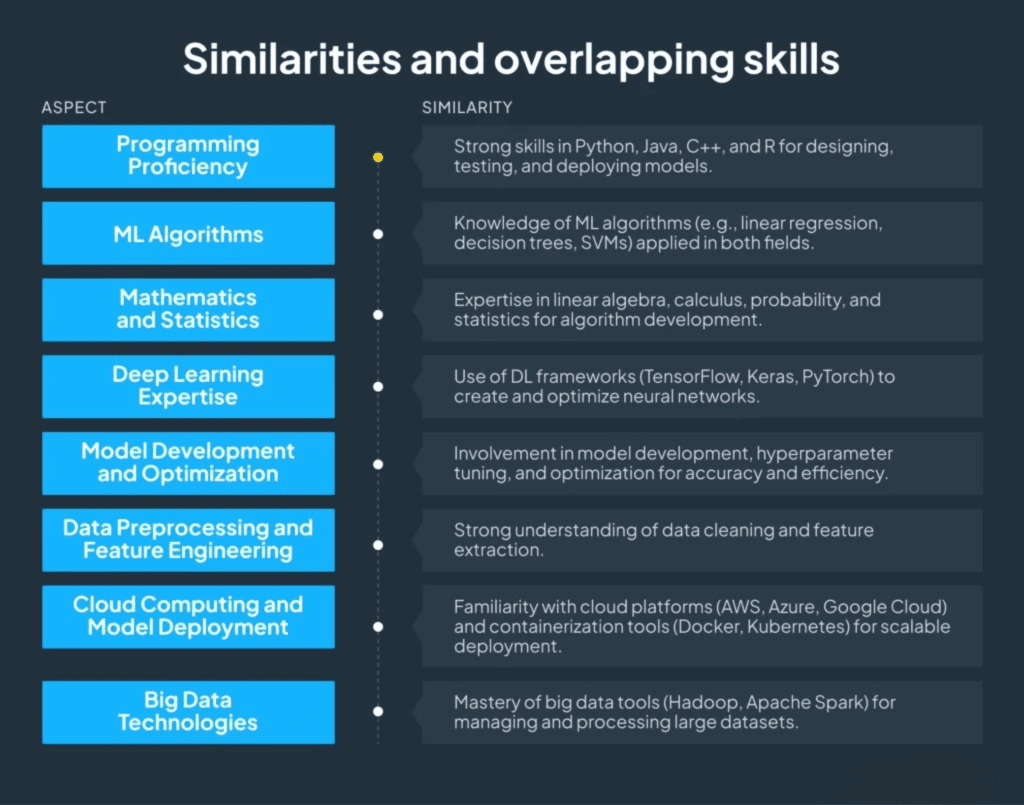
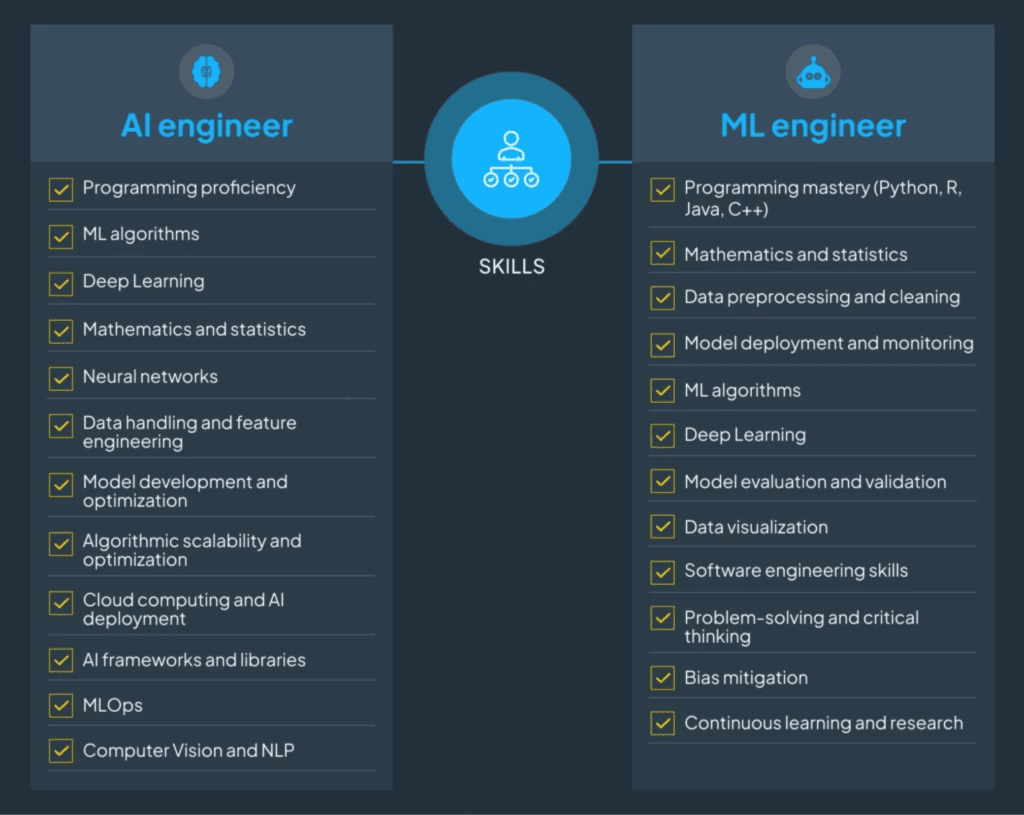
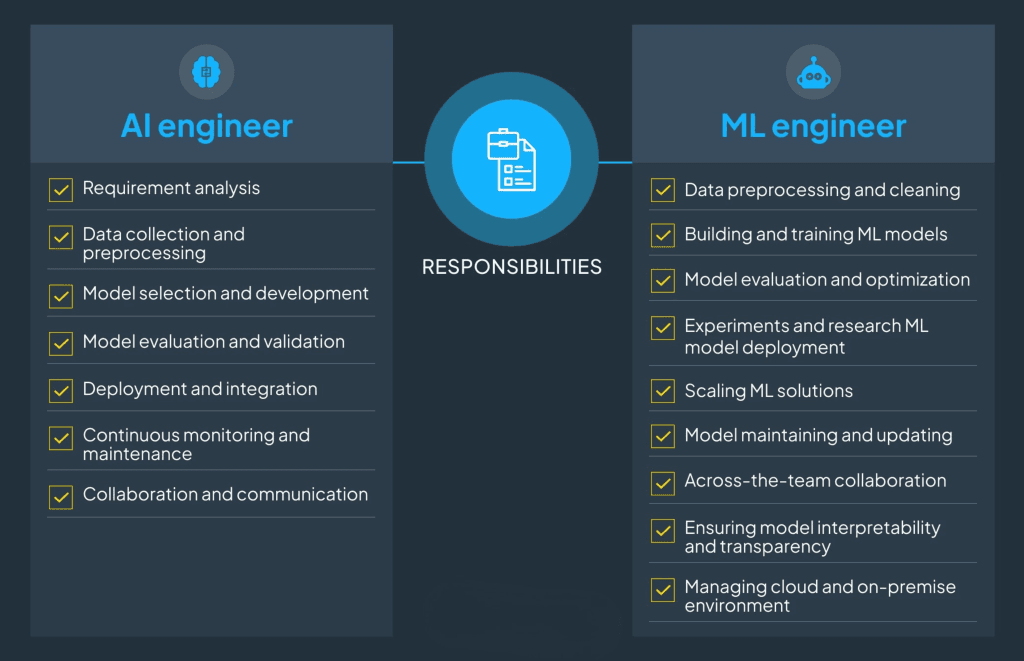
- Data Scientists are great at exploring data, running experiments, and finding insights.
- Machine Learning Engineers focus on turning those insights into production-ready models.
- AI Engineers take it one step further, embedding intelligence directly into your products and workflows.
Without this clarity, you’ll end up with mismatched expectations: someone skilled in computer vision trying to optimize your logistics data, or a researcher lost in a product sprint.
So, before you hire, write down:
- The problem you’re solving.
- The data you already have (and how clean it is).
- The measurable outcome you expect in 3–6 months.
When you’re clear on these three, your hiring process becomes ten times easier. You’ll attract candidates who understand why their work matters, not just what tools to use.
Remember, clarity is the first filter. If you can’t define what you need, even the best AI engineer can’t deliver it.
Step 2: Craft a Job Description That Attracts the Right Candidates
Let’s be honest: most AI/ML job descriptions sound like a grocery list written by ChatGPT.
“Must know Python, TensorFlow, PyTorch, Keras, R, C++, SQL, cloud, and possibly quantum computing.”
The result?
You scare off great engineers and attract people who just copy-paste frameworks into their résumés.
A great job description doesn’t just describe tasks. It sells a mission.
Here’s how to do it right:
1. Lead With Why, Not What
Open with a single line that tells candidates why your company exists and how AI fits into the bigger picture.
For instance,
“We’re building smarter retail experiences using AI-driven demand prediction to help us make shopping effortless.”
Remember, top engineers want purpose, not just perks.
2. Be Specific About the Impact
Instead of vague fluff like “work on exciting AI projects,” write:
“You’ll design and deploy ML models that predict sales trends across 10,000+ SKUs in real time.”
That’s concrete. It shows scale, challenge, and real-world impact.
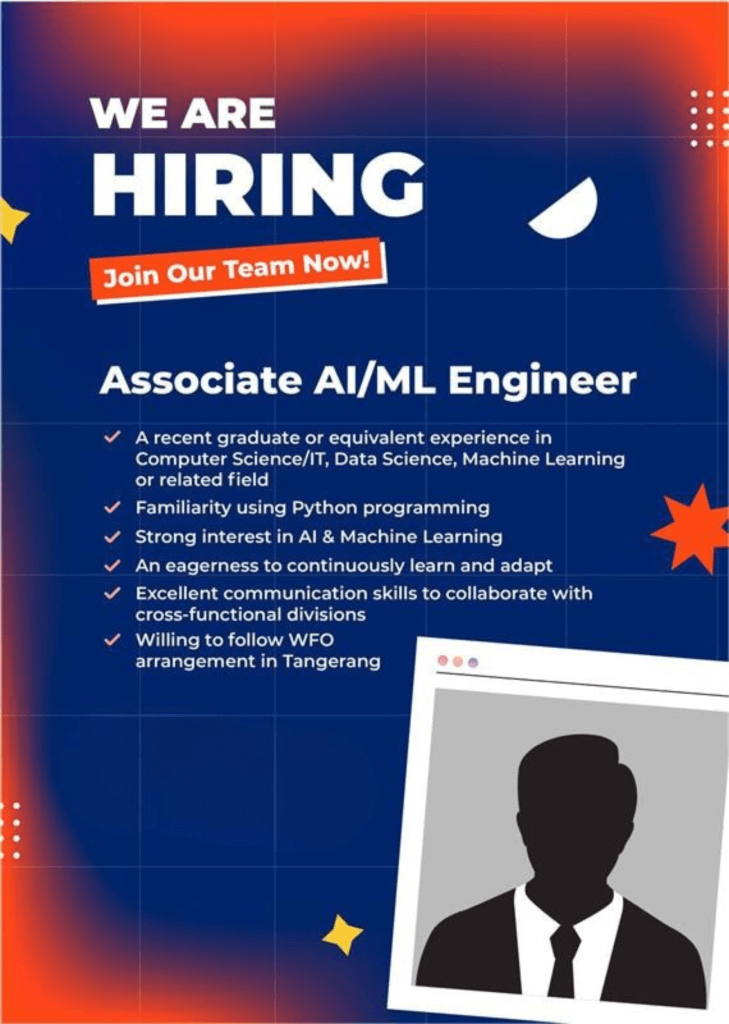
3. List Skills That Actually Matter
Keep your stack practical and relevant. Here’s what you should ask for:
- Must-haves: Python, TensorFlow/PyTorch, data preprocessing, model evaluation, MLOps (CI/CD, Docker, AWS/GCP).
- Nice-to-haves: NLP, time-series analysis, or computer vision depending on your domain.
- Soft skills: Problem-solving, communication, collaboration, and ownership mindset.
A candidate who can explain a model to your marketing team is more valuable than one who can only tune hyperparameters.
4. Don’t Oversell or Underpay
Avoid phrases like “rockstar” or “AI ninja.” Real engineers hate that.
And if your budget says “intern,” don’t post for a “Senior AI Lead.” It only wastes everyone’s time.
5. Include a Quick Note on Your Data
Good engineers care about data quality. Mention what they’ll work with.
For instance, add something like —
“We have structured sales and behavioral data from 1M+ customers, ready for model training and experimentation.”
It signals maturity.
Pro Tip: End your job description with an invitation, not a requirement.
Here’s an example:
“If you’re passionate about turning data into real-world impact, we’d love to talk.”
That single line filters in motivated candidates faster than a 50-question test.
Step 3: Where and How to Source Top AI/ML Engineers
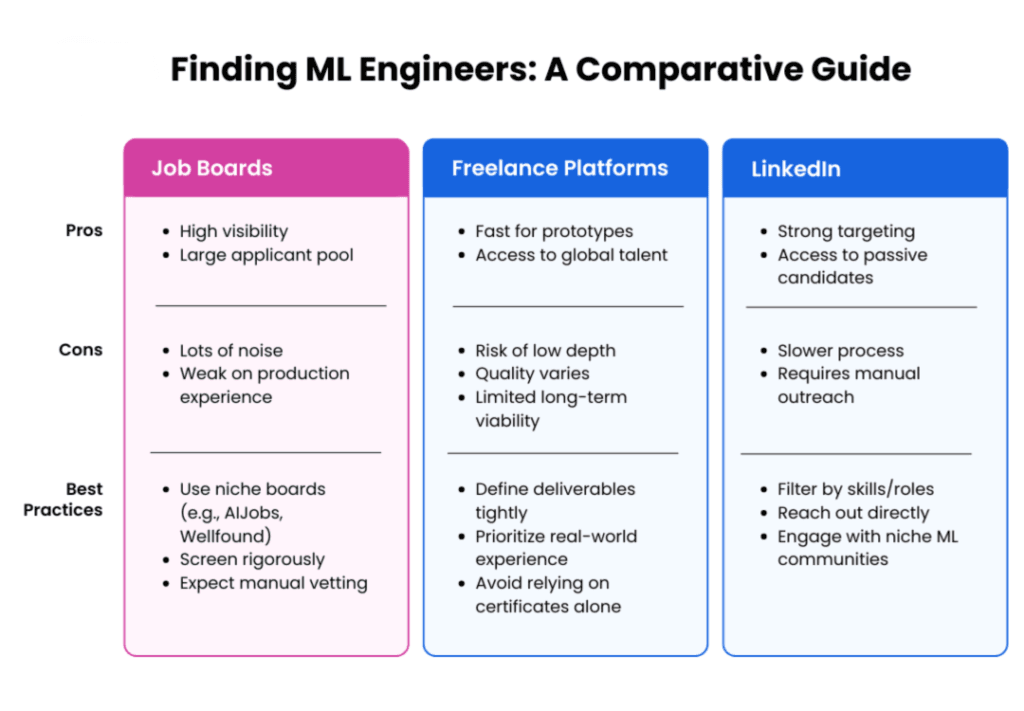
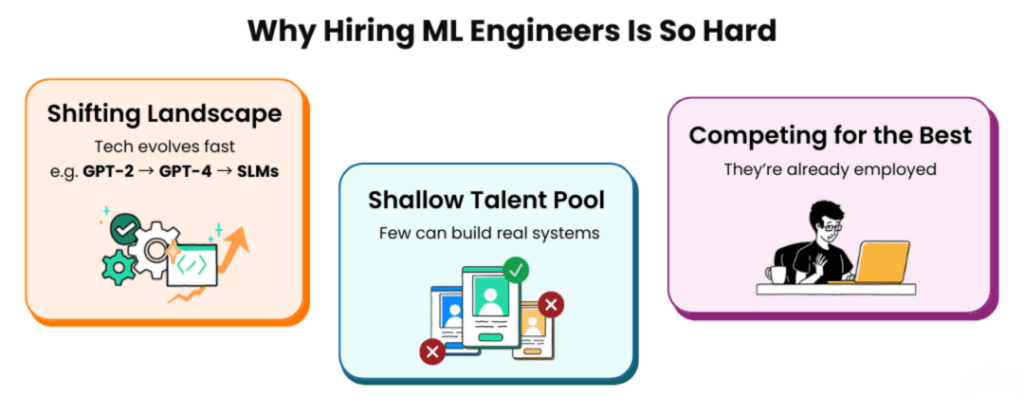
To be frank, posting only on LinkedIn and hoping for magic won’t cut it. The best AI/ML engineers rarely apply through job boards.
They’re too busy solving problems, winning Kaggle competitions, or pushing commits to GitHub at 2 a.m.
So, where do you actually find them?
1. Go Where the Code Lives
GitHub, Kaggle, and Stack Overflow are gold mines. Look for engineers who contribute to open-source ML projects, share notebooks, or have meaningful discussions in forums.
Real engineers leave fingerprints. You just have to follow the trail.
2. Use LinkedIn the Smart Way
Skip the generic “AI Engineer” search. Instead, use Boolean searches like:
“machine learning engineer” AND (“model deployment” OR “MLOps”) AND Python
Filter for candidates who have written about their work, not just listed buzzwords. Check activity, recommendations, and project links.
3. Tap Into Communities, Not Just Platforms
Join Slack groups, Discord channels, and local AI meetups. Many great engineers prefer community collaboration over recruitment portals.
You can also sponsor a data challenge or host a small hackathon. It will get you visibility and interested talent in one shot.
Also, start networking with potential candidates months before hiring. Comment on their GitHub projects, share their work, or invite them to discuss challenges your team faces.
By the time you’re ready to hire, you’ll already have trust built in.
4. Look Beyond Borders
The best part about AI talent? It’s global.
Hiring remote AI/ML engineers gives you access to top talent without the Silicon Valley price tag.
There are a lot of individual AI/ML developers and staff augmentation companies who can give you access to pre-vetted talents that will seamlessly become your extended team, even from the opposite corner of the globe.
Just make sure you evaluate for time zone overlap, communication skills, and prior remote work experience.
Pro Tip: The strongest candidates are often not looking. They’re open to opportunities that feel meaningful. Don’t only chase resumes, start conversations.
Step 4: Screen Smart, Not Hard
Let’s face it, most AI interviews are broken.
Endless whiteboard math, questions about obscure algorithms, and “how would you build a neural net from scratch?” tests that no one actually does in real life.
You’re not hiring a researcher from OpenAI. You’re hiring someone who can solve real problems with real data.
Here’s how to screen efficiently, without burning your team (or the candidate) out.
1. Start With a Conversation, Not an Exam
Begin with a short call. Ask them to explain a recent project in plain English.
- What was the goal?
- How did they measure success?
- What went wrong?
You’ll instantly see who understands end-to-end problem solving versus who just copies notebooks from GitHub.
2. Give Practical Challenges
Forget trick questions. Instead, share a small dataset and a real-world objective.
For example:
“Predict customer churn based on usage data and explain what features you’d prioritize.”
This way, you’ll see their thinking process: how they handle data cleaning, model selection, and trade-offs.
Remember, It’s not about perfection; it’s about reasoning.
3. Look for Signs of Production Thinking
Many candidates can train models. Few can deploy and maintain them.
So, look for skill-sets beyond flashy CVs. Ask:
- How would you monitor a model after deployment?
- What tools do you use for version control or CI/CD?
- How do you handle model drift?
A good ML engineer talks about pipelines, reproducibility, and monitoring; not just accuracy scores.
4. Evaluate Communication and Collaboration
AI is a team sport. Your engineer will need to work with developers, designers, and product managers.
If they can’t explain a concept like “overfitting” without sounding like a textbook, that’s a red flag.
A great engineer makes complex things simple, not the other way around.
5. Use Peer Review Wisely
Involve your senior data or ML engineers in the screening process. They’ll spot red flags faster than HR ever could. But make sure they evaluate based on relevance, not ego.
You don’t need theoretical perfection, you need practical problem-solvers.
Pro Tip: The best screening process feels like collaboration, not interrogation. If a candidate leaves your interview more excited about your project, you’re doing it right.
Step 5: Conduct Final Interviews that Balance Skill and Fit
By this stage, you’ve filtered out the buzzword warriors. Now it’s time to find out who can actually thrive in your environment.
Because even the smartest AI/ML engineer will fail if they don’t fit your team’s rhythm or understand your business goals.
Here’s how to make the final evaluation count.
1. Go Beyond Technical Mastery
At this stage, assume everyone can code. Now you’re looking for something rarer: judgment.
Ask how they decide when to use a model, not just how to build one.
For Instance, Ask something like this —
“Tell me about a time when you decided not to use AI. What made you change direction?”
This way, you’ll learn who can think strategically and avoid building fancy models for the wrong problems.
2. Test for Curiosity and Clarity
Great AI/ML engineers are lifelong learners.
Ask what new tech or research they’ve been exploring lately and why it matters.
If they can break down a complex paper in simple terms, you’ve got a communicator, not just a coder.
Pro Tip: Bring in someone from marketing, product, engineering, or design to join the interview. You’ll see how well they adapt their communication style across disciplines.
If your marketing lead can understand their answer, hire them; they’re a keeper. Because in reality, AI projects succeed when data, design, and delivery move in sync.
3. Check for Ownership Mindset
Technical brilliance means little without accountability. You want engineers who don’t just build models, but own them through every stage of the lifecycle.
So, ask questions like:
- If a deployed model suddenly performs poorly in production, what would you do first?
- How do you approach a project when requirements or data change midway?
Listen for signs of accountability, not blame. The best engineers take ownership of outcomes, not just output.
Ownership means caring about results, not just releases.
It’s the difference between an engineer who says, “The model worked fine on my machine,” and one who says, “Let’s fix this for production users.”
Look for candidates who talk in terms of impact and users, not just accuracy metrics. That mindset will save you from 2 a.m. Slack pings, endless blame loops, and “not my job” silos later on.
4. Align on Values and Vision
Before closing the deal, make sure they understand why your company does what it does.
- Do they resonate with your mission?
- Do they get excited talking about your data problems?
People who feel connected to the vision stick longer and deliver better results.
Pro Tip: The best final interview feels less like an evaluation and more like a strategy session. If you walk away thinking, “I’d love to build with this person,” you’ve probably found your hire.
Budgeting for Brilliance: How to Plan (and Not Panic) When Hiring AI/ML Talent
Let’s be real: hiring great AI/ML engineers isn’t cheap.
But hiring the wrong one? That’s how budgets implode faster than a misconfigured AWS bill.
So, before you start throwing salary numbers into the wind, let’s talk about what actually drives cost, and how to budget smart without cutting corners.
1. Know What You’re Paying For
AI/ML engineers come in many flavors, and so do their price tags.
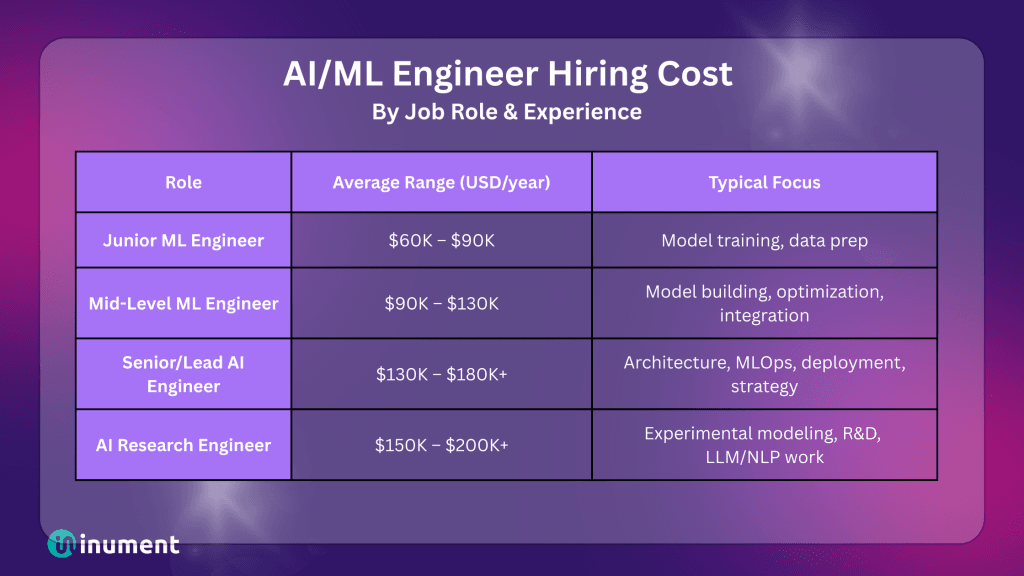
Of course, these vary wildly by region. A senior engineer in Eastern Europe or South Asia might deliver the same quality for half the cost of a Silicon Valley hire.
2. Factor in the Hidden Costs
Beyond salaries, there’s infrastructure, cloud costs, and tools. Training large models on GPU-heavy environments can rack up expenses faster than you think.
Don’t forget time: bad hires cost months in delays and retraining. So investing upfront in a thorough hiring process actually saves money later.
3. Balance In-House and Offshore Talent
Startups often benefit from a mixed teams: a lean in-house/nearshore core team supported by seasoned offshore AI/ML engineers.
Although these two models are completely different, this hybrid approach cuts costs while keeping strategic control in-house.
Enterprises, on the other hand, can scale faster through staff augmentation: bringing in specialized engineers for high-impact projects without long-term overhead.
Smart budgeting isn’t about finding the cheapest option. It’s about blending skill, scalability, and sustainability.
4. Pay for Impact, Not Hype
Avoid being dazzled by titles or degrees. A self-taught engineer who’s deployed production-ready models might outperform a PhD who’s never shipped a line of code.
Focus your budget on proven outcomes, not theoretical potential. So rather than asking for publications, evaluate solid portfolios.
5. Build a Long-Term View
AI is not a one-time investment, it’s a capability. Plan for continuous improvement, retraining models, and evolving infrastructure.
The engineers you hire today will shape how adaptive and scalable your AI systems become tomorrow.
Also, don’t forget about post-deployment realities (MLOps, scaling, maintenance). Remember, treat AI hiring like product investment. You’re not just buying skills; you’re building future velocity.
Common Pitfalls to Avoid When Hiring AI/ML Engineers
Hiring AI/ML engineers can feel like navigating a maze blindfolded. You think you’ve found a genius… until they spend six months fine-tuning a model no one needs.
The truth is, most bad hires aren’t bad people. They’re just mismatched for the problem, the process, or the pace.
Here’s how to stay out of the usual traps, and how to sidestep them:
- Hire for purpose, not hype — Don’t chase buzzwords. Define your business goal first, then find the skillset that fits it. “Let’s bring in AI and see what happens” never ends well. Start with a roadmap and measurable objectives.
- Don’t confuse research with delivery — A strong academic background doesn’t guarantee shipping results. Look for engineers who’ve deployed models in production.
- Never ignore the data reality — Your data is never as clean as your ambitions. Hire people who’ve worked with messy, real-world datasets.
- Avoid over-engineering simple problems — Not every task needs deep learning. Choose engineers who prioritize ROI over model complexity.
- Keep a sharp eye on communication — AI needs translators, not just coders. Pick candidates who can explain models to non-technical teams.
- Don’t Forget culture fit — Even great engineers fail in the wrong environment. Match technical depth with your team’s pace and workflow.
- Deployment know-how is a must — If they’ve never touched MLOps or cloud infrastructure, expect scaling headaches. Verify end-to-end experience for technical evaluation.
- Don’t neglect post-hire setup — Even top engineers need context. Provide clean data, clear goals, and collaboration channels from day one.
A single bad hire can drain budgets, delay releases, and erode trust in your AI strategy. Bad hires can break models faster than you can say “overfitting.”
That’s why hiring right isn’t about speed, it’s about alignment.
This is exactly why Inument has helped companies avoid these pitfalls by aligning technical talent with product vision and operational goals.
We focus on matching engineers who not only build models but understand why they matter; so your data works harder, smarter, and faster.
Wrapping Up: Turning Data into Direction Starts with the Right People
It’s true that AI is changing the future of technology and business. But, AI success isn’t just about the algorithms you use. It’s about the people who build, refine, and adapt them to your business reality.
A skilled AI/ML engineer doesn’t just write code; they interpret your data, challenge assumptions, and translate chaos into clarity. They connect models to meaning, and meaning to measurable growth.
When you hire right, AI becomes more than a buzzword. It becomes a force multiplier. Your models get smarter. Your decisions get faster.
Your systems get leaner. But it starts with clarity: knowing what you need, defining outcomes, and bringing in people who can turn raw data into direction.
At Inument, we’ve seen how the right engineers transform organizations from data-rich to data-driven. Not through flashy tech, but through thoughtful engineering, strong collaboration, and business-aligned problem solving.
So before you rush to hire, pause to align. The right people don’t just understand your data. They also understand your vision, and make it real.
Ready to find the AI/ML engineers who can turn your data into results?
Let’s connect and explore how you can build a team that actually delivers impact: fast, focused, and future-ready!
About the Author

admin
Related Insights

The Secret Behind Why Startups and Enterprises Prefer React JS
30 December 2025

Smart Strategies for Hiring Top-Tier Tech Staff in Singapore
17 December 2025

Nearshore vs Offshore Outsourcing: How to Make the Best Choice for Your Business
10 December 2025

React Developer Hiring Guide: How to Build the Perfect Frontend Team
03 December 2025

How to Choose the Right Flutter Developer for Cross-Platform Success
25 November 2025
